



Fatal Crashes Involving Young Drivers Down
Steep fall in 20 years credited to new programs and policies, including graduated licenses.


Members of the younger cohort are less likely to drive now than 20 years ago, but the group said that fact accounts for a small part of the decrease.
IMAGE: Pexels/Elijah O'Donnell
Newly released research shows that fatal crashes involving young drivers have fallen nearly 40% in the 20 years ended in 2022.
The dramatic decrease came thanks to several programs and policies that have been put in place across the country, said the Governors Highway Safety Association, which compiled the data and recommended a sixth program to build on the gains.
The association said fatal crashes involving drivers younger than 21 fell 38% in the 20-year period and improved in all but three states and Washington, D.C. They increased nearly 8% for drivers 21 and older during the same period. It said young drivers are almost four times more likely to be involved in fatal crashes but that the fatality rate fell steeply. Deaths of young drivers dropped about 45% while they rose 11% for drivers 21 and older.
Members of the younger cohort are less likely to drive now than 20 years ago, but the group said that fact accounts for a small part of the decrease.
“Young drivers are the riskiest age group on the road, and the reasons are straightforward – immaturity and inexperience,” said report author and association Senior Director of External Engagement Pam Shadel Fischer, whom it described as a national teen-driver safety expert.
Fischer pointed out that human brains aren’t fully developed at the younger driving ages, particularly the areas that control risk assessment and decision-making to help prevent crashes, and the consequences affect all age groups.
“In 2021, 63% of the people killed in crashes involving a young driver were their passengers, occupants of other vehicles or pedestrians or bicyclists,” she said.
The group credits five advancements for the improvements in young-driver safety: graduated driver license programs; parents’ involvement in monitoring and coaching young drivers; driver-education; peer-to-peer traffic safety education; and safer vehicles, including technologies like blind-spot monitors and lane-keeping assistance.
It recommends building on those policies and programs and adding training on the newer vehicle technologies to driver education.
DIG DEEPER: IIHS: Cameras, Telematics Could Shed Light on Driver Cell Use
Originally posted on Auto Dealer Today
More F&I

AI: Facilitator, Not Fixer, in F&I
The dealerships that thrive in the years ahead will be those that embrace technology while continuing to invest in the people who make customer interactions count.
Read More →
Modern Technology Objection Handling
In this video, Trent White shares how to confidently handle technology-based objections by helping customers understand the value of protection, even with modern vehicle technology.
Read More →
Consistency at Scale: Driving F&I Performance
With 75 rooftops across the Sunshine State, Morgan Auto Group has proven to Floridians that it knows a thing or two about driving performance in a competitive market. But it didn’t start at the top.
Read More →
Gitty Up on GAP
The foundational finance-and-insurance product hasn’t kept up with the latest conditions for auto dealers. Is the time ripe?
Read More →
How AI-Powered Coaching Is Transforming F&I Performance
See how AI-powered coaching can turn F&I customer conversations into actionable insights that support compliance, performance and profitability
Read More →
Sell Value, Build Trust
In this video, Trent White explains why selling on value, not fear, builds lasting customer trust, reduces cancellations, and drives long-term success.
Read More →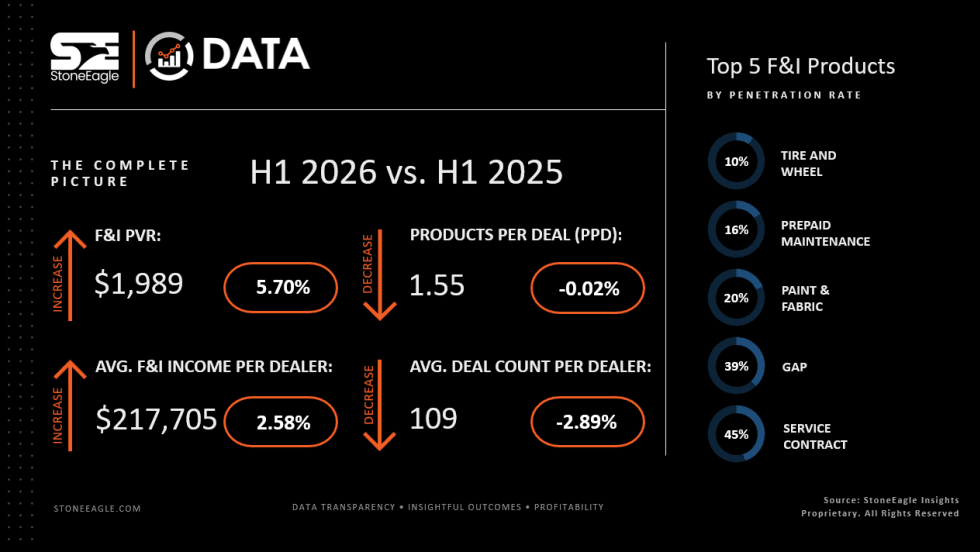
F&I Sales Give Dealers First-Half Lift
Product business shored up total profits to avoid an overall revenue tanking as product penetrations held steady, StoneEagle reported.
Read More →
Targeted Training Drives Results
Today’s technology, instead of threatening F&I managers, can actually make them better, according to an industry veteran who’s watched market setbacks roil the unprepared.
Read More →
Double the Change, Double the Chance
When an F&I manager gets a customer refusal, it’s a wise move to tweak more than one thing in the product offering.
Read More →
Just Do It
F&I managers need training, but instead of resisting application or expecting perfection, they should improve by simply acting on what they learn.
Read More →