



Fed Reserve Approves Second Rate Hike This Year
The Federal Open Market Committee approved a quarter-point hike in the federal funds rate. While auto loans aren’t expected to change much, the rate increase will cost credit card users roughly $1.5 billion in extra finance charges this year, according to one estimate.

WASHINGTON, D.C. — With solid but moderating job gains and economic activity rising moderately, the Federal Reserve approved its second interest rate hike during its Federal Open Market Committee (FOMC) meeting on Wednesday.
The committee’s 8-to-1 vote — Minneapolis’ Noel Kashkari preferring to maintain the existing target range until inflation picks up — raises the federal funds rate a quarter point to a target range of 1% to 1.25%. With inflation on a 12-month basis expected to remain below 2% in the near term but stabilize around the Fed’s 2% objective over the medium term, the committee said near-term risks to its economic outlook “appear roughly balanced.”
“Our decision to make another gradual reduction in the amount of policy accommodation reflects the progress the economy has made, and is expected to make, toward maximum employment and price stability objectives assigned to us by law,” said Federal Reserve Board Chair Janet Yellen. “However, with employment near its maximum sustained level and the labor market continuing to strengthen, the committee still expects inflation to move up and stabilize around 2% over the next couple of years, in line with our longer-run objective.
“Nonetheless, in light of the softer recent inflation readings, the committee is monitoring inflations developments closely,” she added.
Economic growth has rebounded since the slowdown in the first quarter, resulting in a moderate pace of growth so far this year, the committee noted. Household spending, which was particularly soft earlier this year, has been supported by solid fundamentals, it added, including ongoing improvement in the job market and relatively high levels of consumer sentiment and wealth.
Business investment, which was weak for much of last year, has continued to expand, the Fed noted. And exports have shown greater strength this year.
“Overall, we continue to expect that the economy will expand at a moderate pace over the next few years,” Yellen said.
In the labor market, job gains have averaged about 160,000 per month since the start of the year, a solid growth rate despite being a little slower than last year. According to the Fed, the unemployment rate has fallen about a half a percentage point since the beginning of the year and was at 4.3% in May, a low level by historical standards and just below the median of committee member estimates of their long-run normal level.
Broader measures of labor market utilization have also improved this year, Yellen noted, adding that participation in the labor market has been little changed on a net basis for about three years. “Given the underlying downward trend in participation stemming largely from the aging of the U.S. population, a relatively steady participation rate is a further sign of improving conditions in the labor market,” Yellen said. “Looking ahead, we expect that the job market will strengthen somewhat further.”
As for inflation, the 12-month change in the price index for personal consumption expenditures was 1.7% in April, up from less than 1% last summer but down somewhat over the past few years. Core inflation, which excludes food and energy categories and tends to be a better indicator of future inflation, has also edged lower, the Fed said.
“The recent lower readings on inflation have been driven significantly by what appear to be one-off reductions in certain categories of prices, such as wireless telephone services and prescription drugs,” Yellen noted. “These price declines will, as a matter of arithmetic, restrain the 12-month inflation figures until the extraordinary low March reading drops out of the calculation.”
The fed’s median projection for growth of inflation-adjusted gross domestic product is 2.2% this year. It then edges down to 1.9% by 2019, slightly above the committee’s estimated longer-run rate. The median projection for the unemployment rate stands at 4.3% in the fourth quarter before ticking down to 4.2% in 2018 and 2019.
Policymakers also issued forecasts showing another three quarter-point rate increases in 2018.
With this week’s rate hike, auto loans aren’t expected to change much. According to WalletHub.com, the average APR on a 48-month new-vehicle loan rose from 4% in November 2015 to 4.52% in February 2017. The Fed had approved a rate hike in December 2015 but held off on its second increase in 10 years until this past December.
Credit card users are expected to feel the rate increase the most, costing them roughly $1.5 billion in extra finance charges this year. When the three previous rate hikes are factored in, credit card users will wind up paying about $6 billion more in 2017 than they would have otherwise, according to Wallethub.com. The firm expects outstanding credit card balances to surpass $1 trillion in 2017.
More F&I

Sell Value, Build Trust
In this video, Trent White explains why selling on value, not fear, builds lasting customer trust, reduces cancellations, and drives long-term success.
Read More →
F&I Sales Give Dealers First-Half Lift
Product business shored up total profits to avoid an overall revenue tanking as product penetrations held steady, StoneEagle reported.
Read More →
Targeted Training Drives Results
Today’s technology, instead of threatening F&I managers, can actually make them better, according to an industry veteran who’s watched market setbacks roil the unprepared.
Read More →
Double the Change, Double the Chance
When an F&I manager gets a customer refusal, it’s a wise move to tweak more than one thing in the product offering.
Read More →
Just Do It
F&I managers need training, but instead of resisting application or expecting perfection, they should improve by simply acting on what they learn.
Read More →
Dealer Lender Preferences Revealed
When lenders provide consistent, fast service, their overall satisfaction scores with dealers greatly improve, according to JD Power research.
Read More →
Leading with Purpose
In this video, Trent White explains how understanding your people’s 'why' is a key leadership responsibility of F&I professionals and how that mindset drives dealership engagement, trust and performance.
Read More →
Integrating Nontraditional F&I Products
The niche presents a strategic advantage for auto dealerships as they move to adapt to fast-changing consumer expectations in today’s market.
Read More →
Trust Is Personal
Technology, no matter how efficient, can’t replace what the human F&I manager can do, which is to bridge the divide between cyberspace and the in-store experience.
Read More →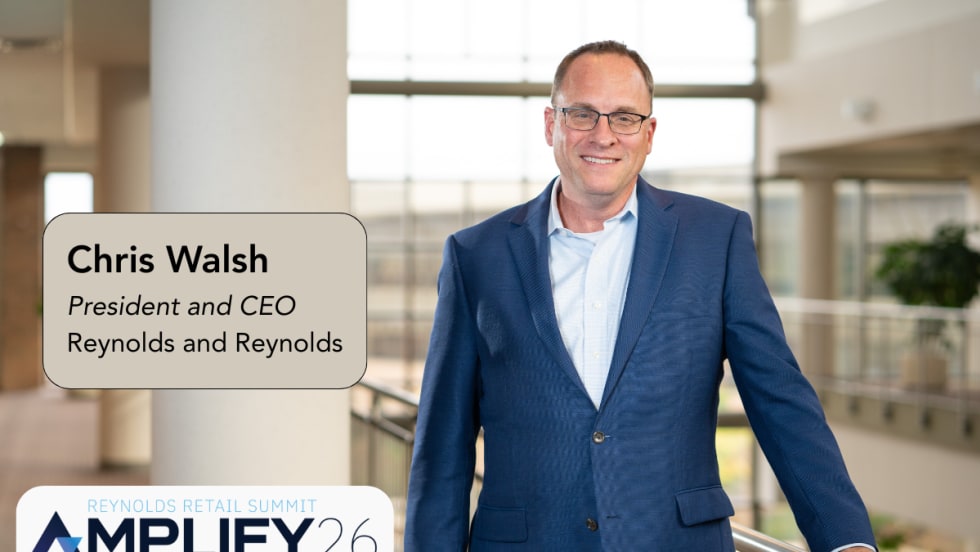
Amplify 2026 Billed as Turning Innovation Into Results
Reynolds and Reynolds says its annual retail summit will connect dealers with practical strategies, peer insight, and technology-driven ideas.
Read More →