



Financial Organizations Must be Prepared to Navigate Regulatory Environment in 2009
Financial organizations will need to be focused and proactive as they plot their course to successfully navigate the regulatory environment of 2009, according to experts at Wolters Kluwer Financial Services, a provider of compliance and operational risk management solutions to financial organizations.
MINNEAPOLIS –– Financial organizations will need to be focused and proactive as they plot their course to successfully navigate the regulatory environment of 2009, according to experts at Wolters Kluwer Financial Services, a provider of compliance and operational risk management solutions to financial organizations
Successful organizations will be those that are not only able to adjust to a changing regulatory landscape, but ones that can also demonstrate they are embracing the letter and the spirit of the law, experts say.
“The country’s financial and economic crisis is really prompting everyone to look at our current regulatory system and ask, ‘What can we do better?’” said David Thetford, securities compliance principal analyst at Wolters Kluwer Financial Services. “The regulatory structure needs to be reviewed from the ground up. We need to identify the goals we are trying to achieve through regulation and what regulatory structure is best to achieve those goals.”
Thetford noted that this could encourage and promote a lean toward principles-based regulation, a model that has already received a lot of attention from the Securities and Exchange Commission (SEC) and the Financial Industry Regulatory Authority (FINRA).
Kathy Donovan, manager of government relations for Wolters Kluwer Financial Services’ Insurance Compliance Solutions group, agrees the basic premise of principles-based regulation—doing right by the customer—will likely be paramount in the financial services industry as we enter 2009.
“There continues to be a growing interest in protecting consumers—particularly the senior population,” said Donovan. “Within the insurance industry, we’ve seen many recent examples, including the National Association of Insurance Commissioners’ (NAIC) new model law to prohibit the use of certain senior-specific designations for insurance agents and many state initiatives to place restrictions on Stranger Originated Life Insurance (STOLI).”
Donovan expects that as the 2009 legislative sessions begin in multiple states, insurers will see variations of the NAIC model law and STOLI restrictions, as well as other consumer-focused regulations, introduced.
The issue of state regulation versus federal regulation, and the potential for discrepancies between the two, will also be in focus in the banking industry in coming months.
“I don’t think we’ll see a lot of new regulations right away at the federal level, but I do think we will continue to see substantial change at the state level, given the recent subprime issues,” said Amy Downey, senior compliance consultant at Wolters Kluwer Financial Services. “State banking regulators haven’t traditionally waited for the federal banking regulators to take the initiative in protecting their citizens.”
Downey says many of the emerging regulations at the state level are fair and anti-predatory lending requirements. And while designed to protect the consumer, these regulations can also sometimes unintentionally inhibit lenders. The requirements can be so onerous that the secondary market will not purchase loans that cannot comply with them.
States may be eager to impose new regulations, but that is not always the solution, according to Edward Kramer, executive vice president for regulatory programs at Wolters Kluwer Financial Services.
“Everyone’s instinct when something goes wrong in the financial services industry is to come up with a new regulation,” said Kramer. “But oftentimes, it really is a matter of fixing what you already have.”
Kramer added that mortgage lending has always been based on the ‘three Cs’—credit, collateral and capacity to pay.
“We lost sight of these basic elements,” said Kramer. “And as a result, many regulators are considering more aggressive postures when it comes to monitoring and enforcement practices.”
Such heightened oversight will also apply to new requirements, such as the Fair and Accurate Credit Transactions Act’s Red Flag Rules, that took effect on Nov. 1, said Kevin Byrne, senior compliance consultant for Wolters Kluwer Financial Services.
“Many institutions have taken a wait-and-see approach to compliance with a new requirement in the past,” said Byrne. “They do the minimum work required to comply and wait to see what regulators will say they have to do additionally during an examination. But the Red Flag Rules are all about protecting consumers’ identities. That’s something near and dear to everyone’s heart — a fact regulators will consider.”
Ted Dreyer, senior attorney with Wolters Kluwer Financial Services, added that some institutions may indeed do the bare minimum to comply with the requirements since not all federal regulators have issued examination guidelines yet, and because the Federal Trade Commission pushed its enforcement deadline back six months. But Dreyer stresses that regulators will not accept the excuse that institutions did not fully understand how to comply with the rules.
“While there may not initially be any heavy penalties or large fines, the slaps on the wrists from regulators are going to be hard and hurt very much from a reputational standpoint with customers,” added Dreyer “No institution wants to be known for failing to protect its customers from identity thieves.”
It is also important to understand that the Red Flag Rules don’t just apply to banks, said Kevin Kopp, director of Indirect Lending for Wolters Kluwer Financial Services.
“The Red Flag Rules have hands-down had the most significant impact on the auto finance industry this year in terms of compliance,” Kopp said. “If identity theft and fraud prevention wasn’t a lender or auto dealer’s main focus this year, it should have been.”
And while many institutions view the cost of putting compliance programs in place to address the Red Flag Rules and other requirements as a financial burden, they can often provide a significant return on investment, according to Byrne.
“Protecting your customers’ identities not only benefits them, but it helps the institution avoid a whole host of fraudulent activities and the large monetary losses that accompany them,” Byrne said. “And you can apply that concept to almost any rule or regulation in the financial services industry. The bottom line is that if you are proactively complying with the letter and spirit behind any law, you are protecting your institution from criminal and financial penalties, as well as enhancing your image in the communities you serve. And that’s good for business across the board.”
More F&I

Why Your F&I PVR Is Misleading You
Here’s a handy checklist of the numbers to track in 2026 instead.
Read More →
Auto Consumer Anxiety Presents Opportunity
A survey of U.S. drivers found the majority are concerned about finances and the economy, but those fears make many ready to buy vehicle-protection products.
Read More →
Humble and Hungry: 12 Rules for an F&I Life
Dustin Gingerich, with a decade in the F&I business under his belt, shares his thoughts on leadership, building trust with customers, and the importance of learning and innovation.
Read More →
Focus on the Opening
F&I managers must learn as much as possible about their customers, starting before they walk into their offices. The bulk of today’s consumers expect that, and good results will follow.
Read More →
F&I Reaches for the Sky
The increasingly important profit center continued making gains in the first quarter, according to StoneEagle data, ancillary products proving more popular as consumers hold onto their buys longer.
Read More →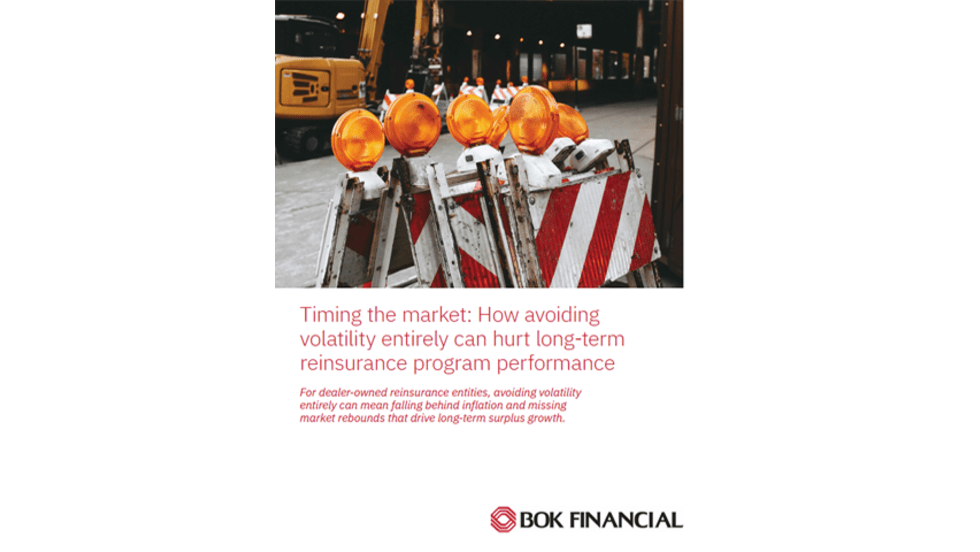
Timing the Market Can Hurt Long-Term Program Performance
For dealer-owned reinsurance entities, avoiding volatility entirely can mean falling behind inflation and missing market rebounds that drive long term surplus growth. Missing just a handful of strong market days can materially impact cumulative returns—an important reminder for long horizon trust and investment strategies.
Read More →
The 90/10 Rule
In this video, Ryan Ruff explains the rule that elite sales professionals use to turn ordinary conversations into unforgettable customer experiences.
Read More →
Your Office Is Talking
What’s the atmosphere saying about you to your customers? You can make minor adjustments and additions that transform your space into one that creates trust with the people on the other side of the desk.
Read More →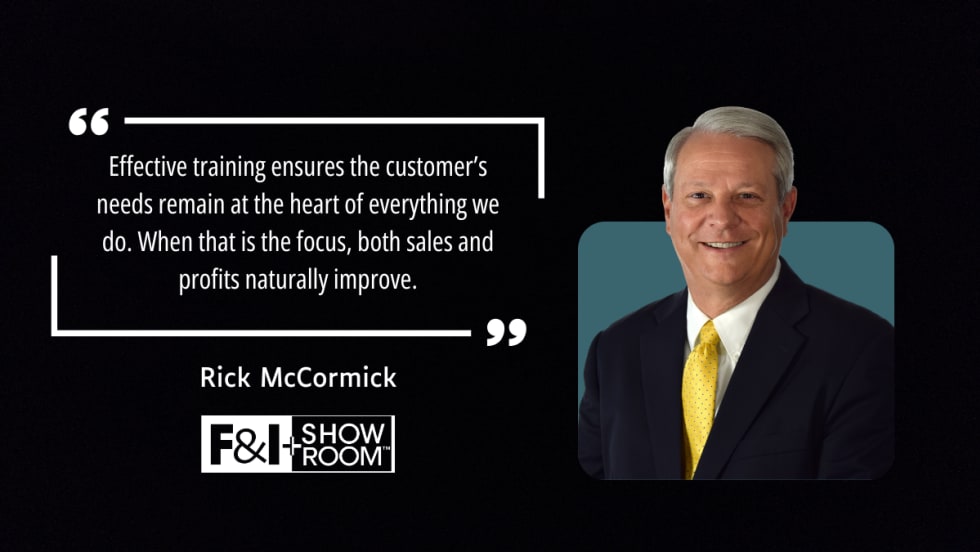
F&I Training Fundamentals
How can auto dealerships help F&I managers fulfill their vital role in the most effective ways? Industry expert Rick McCormick shares his insights on the best ways to train these professionals and help them maintain good habits.
Read More →
Not Just Any Tire Will Do
More consumers and businesses are opting for all-season options for various reasons as safety, sustainability and convenience push practical change.
Read More →