



Ford Motor Credit Reports Third-Quarter Net Losses
Ford Motor Credit officials said lower financing margins, high depreciation expense and the impact of lower average receivable levels played a role in the financing division's reported 52-percent drop in pre-tax profits for the quarter.
Ford Motor Credit officials said lower financing margins, high depreciation expense and the impact of lower average receivable levels played a role in the financing division’s reported 52-percent drop in pre-tax profits for the quarter. Analysts believe unfavorable borrowing rates are only partly to blame.
“The reduced profitability at Ford Motor Credit now shines a more intense light on the weakness of Ford’s fundamental operation — the automotive business,” Kevin Tynan, Argus Research analyst, said in a Reuters news article.
On Monday, Ford Motor Co. posted a quarterly loss of $5.8 billion — its largest loss in 14 years — due to slower truck sales, charges for job cuts and asset write-downs in its North American operations and elsewhere. Its financing division reported net income of $262 million in the third quarter of 2006, down $315 million from earnings of $577 million a year earlier. On a pre-tax basis from continuing operations, Ford Motor Credit earned $428 million in the third quarter, compared with $901 million in the previous year.
Ford executives repeated their belief that Ford Motor Credit is a strategic asset worth keeping, although Don Leclair, Ford’s CFO, said the automaker would explore partnerships in some markets.
Ford Motor Credit also said it plans to restate its earnings from 2001 through the second quarter of 2006 due to accounting errors involving derivative transactions. The division said the restatement would improve results for 2002, but said other periods are under study.
“This is a critical time,” Chief Executive Alan Mulally, a former Boeing Co. executive who took over at Ford in early September, told reporters and industry analysts in a conference call Monday morning. “We dearly recognize it and plan to deal with the business realities we are facing.”
More F&I

Why Your F&I PVR Is Misleading You
Here’s a handy checklist of the numbers to track in 2026 instead.
Read More →
Auto Consumer Anxiety Presents Opportunity
A survey of U.S. drivers found the majority are concerned about finances and the economy, but those fears make many ready to buy vehicle-protection products.
Read More →
Humble and Hungry: 12 Rules for an F&I Life
Dustin Gingerich, with a decade in the F&I business under his belt, shares his thoughts on leadership, building trust with customers, and the importance of learning and innovation.
Read More →
Focus on the Opening
F&I managers must learn as much as possible about their customers, starting before they walk into their offices. The bulk of today’s consumers expect that, and good results will follow.
Read More →
F&I Reaches for the Sky
The increasingly important profit center continued making gains in the first quarter, according to StoneEagle data, ancillary products proving more popular as consumers hold onto their buys longer.
Read More →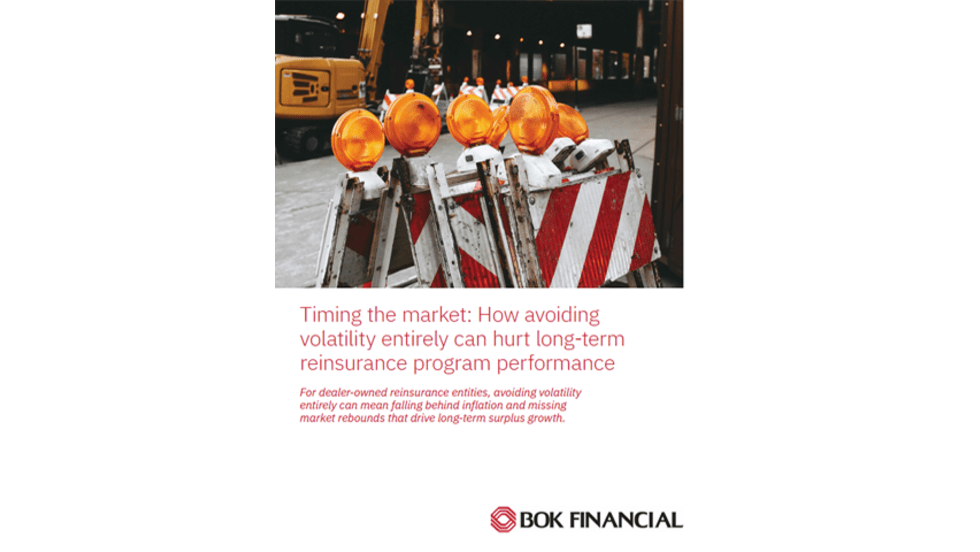
Timing the Market Can Hurt Long-Term Program Performance
For dealer-owned reinsurance entities, avoiding volatility entirely can mean falling behind inflation and missing market rebounds that drive long term surplus growth. Missing just a handful of strong market days can materially impact cumulative returns—an important reminder for long horizon trust and investment strategies.
Read More →
The 90/10 Rule
In this video, Ryan Ruff explains the rule that elite sales professionals use to turn ordinary conversations into unforgettable customer experiences.
Read More →
Your Office Is Talking
What’s the atmosphere saying about you to your customers? You can make minor adjustments and additions that transform your space into one that creates trust with the people on the other side of the desk.
Read More →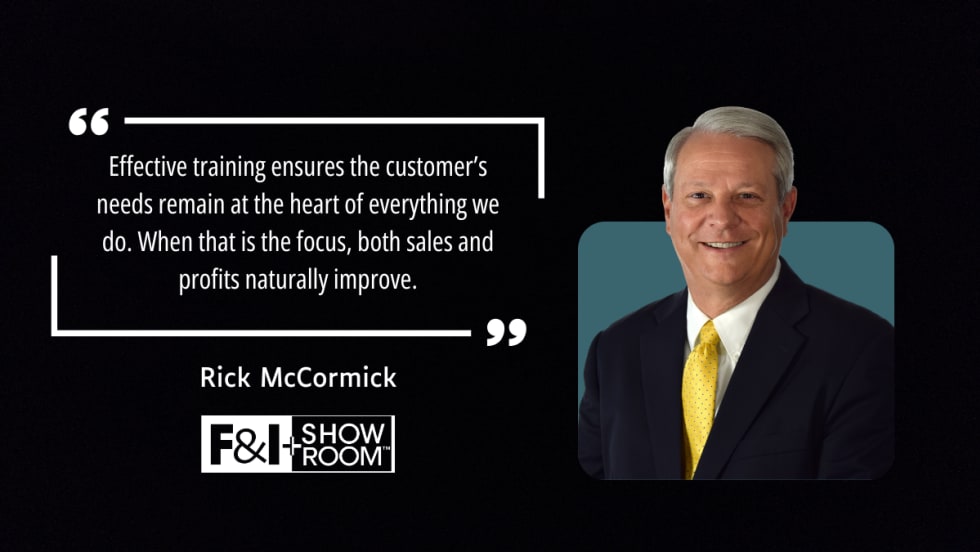
F&I Training Fundamentals
How can auto dealerships help F&I managers fulfill their vital role in the most effective ways? Industry expert Rick McCormick shares his insights on the best ways to train these professionals and help them maintain good habits.
Read More →
Not Just Any Tire Will Do
More consumers and businesses are opting for all-season options for various reasons as safety, sustainability and convenience push practical change.
Read More →