



General Motors, GMAC Agree to Terminate Exclusivity Deal
As part of a deal to access billions in federal aid, GMAC is now allowing General Motors to offer financing through third-party lenders, according to a Jan. 2 filing with the Securities and Exchange Commission (SEC).
WASHINGTON — As part of a deal to access billions in federal aid, GMAC is now allowing General Motors to offer financing through third-party lenders, according to a Jan. 2 filing with the Securities and Exchange Commission (SEC).
The captive finance company, 51 percent owned by Cerberus Capital Management and 49 percent owned by GM, said GM can now offer financing incentives, including leasing and zero-percent loans, through other lenders in certain circumstances until 2013. The filing also said GMAC won’t have to provide lease financing.
GMAC has had an exclusive deal with GM since 2006, requiring GM to offer any competitive finance promotion through GMAC until 2016.
The termination agreement, which was completed on Dec. 29, was part of GMAC’s efforts to raise sufficient capital to meet the Federal Reserve’s requirements for becoming a bank holding company.
The move could also reduce the Detroit automaker’s dependence on GMAC to provide financing, and possibly boost its sales by giving consumers more options for affordable loans.
The captive finance company said the government will get five million preferred shares of GMAC that pays 8-percent interest in exchange for its $5 billion capital injection to help the company avoid bankruptcy.
Additionally, GMAC said in its filing that the government exercised a 10-year warrant to buy 250,000 more GMAC preferred shares for a penny each.
The captive finance company said if the Treasury does not get interest payments on its preferred shares for six consecutive quarters, or more than six non-consecutive quarters, it will get two seats on an expanded GMAC management board.
The filing comes after GMAC’s announcement last week that it would loosen its lending criteria to include retail financing for customers with a credit bureau score of 621 above, which was a significant expansion of credit compared to the 700 minimum score put in place more than two months ago. The announcement also comes after GM’s announcement that it would offer zero-percent or low-interest financing through GMAC on certain models. The federal aid GMAC received made both moves possible.
More F&I
Plug Your Profit Leaks
By building in clear processes, your dealership can realize more profits in plugged leaks to maximize sales opportunities.
Managing Expectations
Learn how proactive communication, setting clear expectations, and providing solutions when plans change can strengthen customer trust and improve the overall service experience.

The F&I Manager's Report Card
The best managers take the time and attention to measure the behaviors behind the numbers.

AI: Facilitator, Not Fixer, in F&I
The dealerships that thrive in the years ahead will be those that embrace technology while continuing to invest in the people who make customer interactions count.

Modern Technology Objection Handling
In this video, Trent White shares how to confidently handle technology-based objections by helping customers understand the value of protection, even with modern vehicle technology.

Consistency at Scale: Driving F&I Performance
With 75 rooftops across the Sunshine State, Morgan Auto Group has proven to Floridians that it knows a thing or two about driving performance in a competitive market. But it didn’t start at the top.

Gitty Up on GAP
The foundational finance-and-insurance product hasn’t kept up with the latest conditions for auto dealers. Is the time ripe?

How AI-Powered Coaching Is Transforming F&I Performance
See how AI-powered coaching can turn F&I customer conversations into actionable insights that support compliance, performance and profitability

Sell Value, Build Trust
In this video, Trent White explains why selling on value, not fear, builds lasting customer trust, reduces cancellations, and drives long-term success.
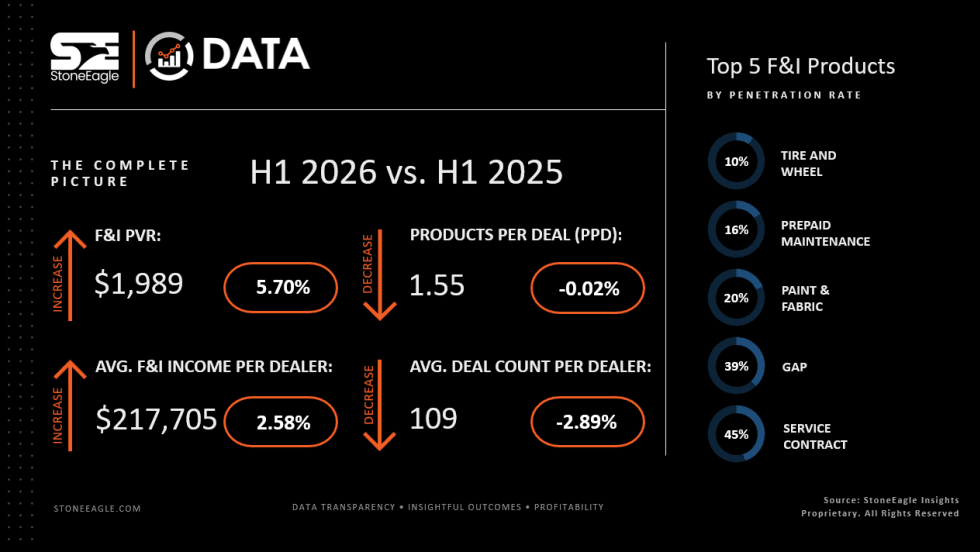
F&I Sales Give Dealers First-Half Lift
Product business shored up total profits to avoid an overall revenue tanking as product penetrations held steady, StoneEagle reported.