



Grant Thornton LLP Predicts a Collapse of Automotive Supply Chain
The economic impact of a General Motors or Chrysler bankruptcy is being debated across the country. But the most immediate and pervasive risk is a wholesale collapse of the automotive supply base, according to Grant Thornton LLP partner Laura Marcero.
DETROIT — The economic impact of a General Motors or Chrysler bankruptcy is being debated across the country. But the most immediate and pervasive risk is a wholesale collapse of the automotive supply base, according to Grant Thornton LLP partner Laura Marcero.
Marcero, part of the firm's Corporate Advisory and Restructuring Services team based in Southfield, Mich., believes some 500 Tier-One suppliers may be at high risk due to the cascading effect of reduced volumes and uncertainty around government support in the near term. But damage can be mitigated if key suppliers form a coalition with automakers, banks and the government to drive an orderly consolidation of the supply base.
"Suppliers struggled to make money when industry volumes were almost double what they are today, and consolidation has been happening mostly among smaller companies at the lower tiers," Marcero said. "Now, we are near a tipping point where the scale and scope of supplier failures at all levels will increase dramatically.
"To right-size capacity levels and promote a viable industry, we believe 30 to 40 percent of all suppliers are at risk due to the necessary alignment of capacity with demand, which should stabilize in the 12 to 14 million-unit range by 2010-2011," she added. "But if the scenario plays out in an uncontrolled fashion, every automaker will almost certainly lose production and incur steep financial losses. Without a structured approach of consolidation to the benefit of the entire supply chain, the industry may lose critical partners with the technology, scale and geographic footprint that are linchpins in the viability equation.
"Suppliers need to proactively determine whether they are a consolidator or a consolidatee," she said. "For those that are best suited to operate as consolidators, they need to step forth and provide solutions."
Marcero addresses how suppliers, the government, banks and the automakers can mitigate the automotive industry’s dire situation.
Suppliers can right-size their operations, evaluate industry trends for its particular commodity and the competitive landscape, and develop a strategic plan. They must win the active support of stakeholders, including the automakers, bank and government.
Marcero suggests the government can greatly increase chances for a successful industry consolidation by taking immediate steps to spur confidence among lenders, stimulate consumer demand for vehicles and give some measure of regulatory relief.
• Provide a government guarantee of the OEM receivables and inventory with the assurance from the lenders that incremental funding will flow to the suppliers.
• Stimulate demand and take more aggressive action to move sales into the 12 to 14 million-unit range as quickly as possible to help inject liquidity into the system.
[PAGEBREAK]
• Consider revisions to the bankruptcy code. The current bankruptcy laws may need to be reviewed so mega automotive cases can continue to pay pre-petition debts. Without removing the "automatic stay" provision of the bankruptcy code, an automaker filing could cause a string of other failures.
• The government should consider the application of certain provisions of anti-trust regulations and how automakers and interested parties can openly discuss how best to facilitate consolidation without fear of government or civil legal action. This would help automakers identify and support the most viable companies.
The supply base's liquidity crisis was set in motion by sharp production cuts, but it has been exacerbated by the lack of credit available from banks and other lenders, Marcero said. Here are key actions lenders can take.
• They should provide affordable financing. The interest rate on loans to finance consolidation efforts should be set at lower rates. These low-cost loans would be used to fund equipment purchases, acquisitions, and wind-down costs associated with moving one supplier's production into the consolidator (whether inside or out of a chapter proceeding).
• Banks could place a moratorium on principal payments and/or renegotiate amortization terms to provide a debt service reprieve until volumes stabilize.
• Finance sources can lend through the downturn. Potentially provide over-formula or "air ball" loans (a loan whose value exceeds the value of the collateral) to allow consolidators to manage through the downturn.
Marcero also suggested key initiatives OEMs should implement to help improve suppliers’ situation.
• Historically, when a key supplier has reached the brink of bankruptcy and production is threatened, an automaker will move its work to a new supplier if it can or step in with cash injections to keep the company afloat. But this practice has been overwhelmed by the sheer number of at-risk suppliers. OEMs and suppliers may need to have frank discussions about the financial health of the supply base, consolidation, and must coordinate a strategy down to the commodity level.
• Err on the conservative side when forecasting volumes for new or resourced programs so suppliers know what to realistically count on for production.
• Support consolidators and help them move proactively and strategically to ensure combined companies have the right product, technology and geographic footprint to meet customer needs.
"Getting this work done with the clock ticking will be hard, but the task is not insurmountable," Marcero concluded. "The rewards for successful execution will be great. With all of the costs and capacity being wrung out of the system, the auto industry may become spectacularly profitable as demand climbs back toward trend levels."
More F&I

Why Your F&I PVR Is Misleading You
Here’s a handy checklist of the numbers to track in 2026 instead.
Read More →
Auto Consumer Anxiety Presents Opportunity
A survey of U.S. drivers found the majority are concerned about finances and the economy, but those fears make many ready to buy vehicle-protection products.
Read More →
Humble and Hungry: 12 Rules for an F&I Life
Dustin Gingerich, with a decade in the F&I business under his belt, shares his thoughts on leadership, building trust with customers, and the importance of learning and innovation.
Read More →
Focus on the Opening
F&I managers must learn as much as possible about their customers, starting before they walk into their offices. The bulk of today’s consumers expect that, and good results will follow.
Read More →
F&I Reaches for the Sky
The increasingly important profit center continued making gains in the first quarter, according to StoneEagle data, ancillary products proving more popular as consumers hold onto their buys longer.
Read More →
Timing the Market Can Hurt Long-Term Program Performance
For dealer-owned reinsurance entities, avoiding volatility entirely can mean falling behind inflation and missing market rebounds that drive long term surplus growth. Missing just a handful of strong market days can materially impact cumulative returns—an important reminder for long horizon trust and investment strategies.
Read More →
The 90/10 Rule
In this video, Ryan Ruff explains the rule that elite sales professionals use to turn ordinary conversations into unforgettable customer experiences.
Read More →
Your Office Is Talking
What’s the atmosphere saying about you to your customers? You can make minor adjustments and additions that transform your space into one that creates trust with the people on the other side of the desk.
Read More →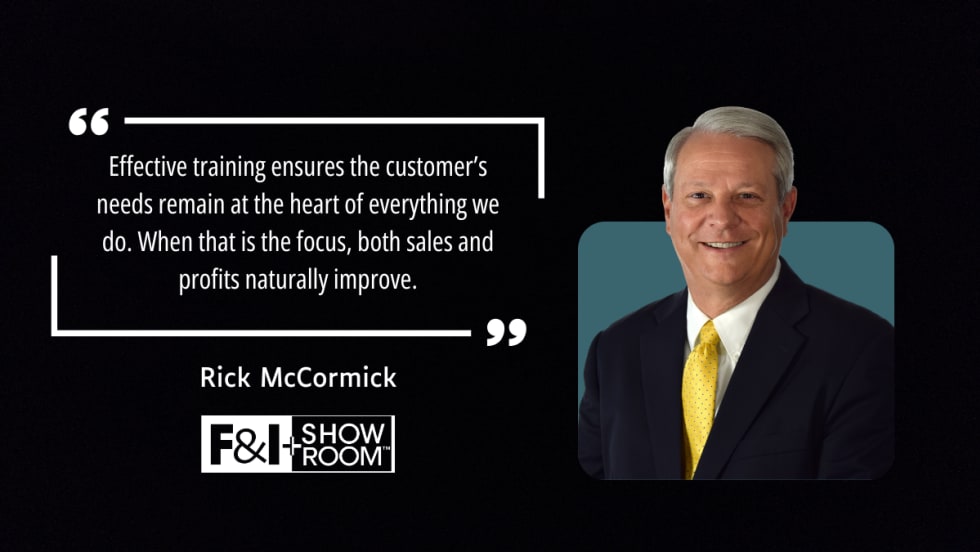
F&I Training Fundamentals
How can auto dealerships help F&I managers fulfill their vital role in the most effective ways? Industry expert Rick McCormick shares his insights on the best ways to train these professionals and help them maintain good habits.
Read More →
Not Just Any Tire Will Do
More consumers and businesses are opting for all-season options for various reasons as safety, sustainability and convenience push practical change.
Read More →