



JD Power: Porsche, Buick Best in Service
A survey of 57,286 car buyers and lessees who visited dealership service departments and independent shops ranks Porsche No. 1 for the first time while Buick leads mass-market brands for the third straight year.

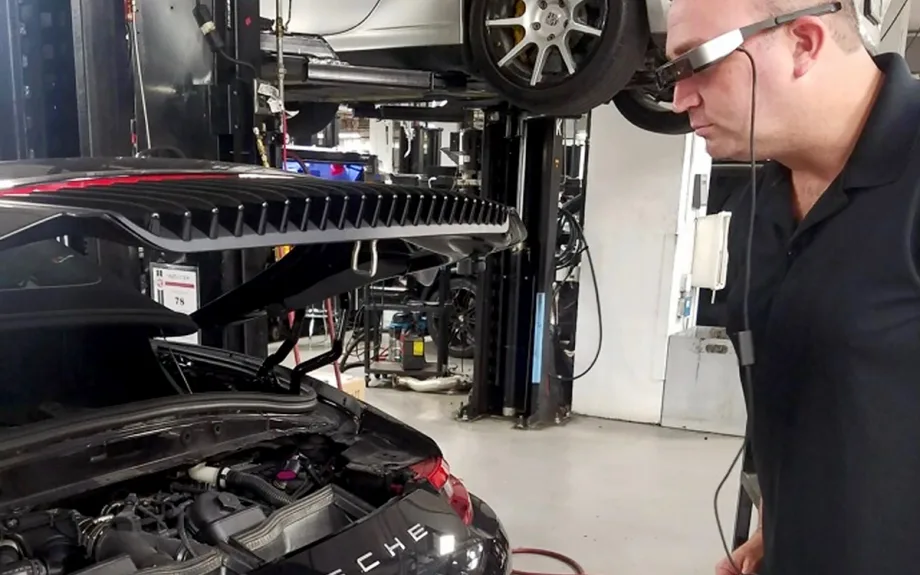
Porsche introduced its smart glasses-powered “Tech Live Look” service software platform in 2017. The German manufacturer earned a score of 893 out of a possible 1,000 points to lead all brands in J.D. Power’s 2019 service customer satisfaction rankings.
Photo courtesy Porsche AG
COSTA MESA, Calif. — Satisfaction scores tend to increase when dealership service departments use customers’ preferred methods of communication; however, dealerships are not regularly doing so, according to the J.D. Power 2019 Customer Service Index Study.
Satisfaction is 75 points higher (on a 1,000-point scale) among customers who had an all-digital experience compared with one that is all analog, analysts said. Most prefer to schedule service via the internet and communicate with the dealer through text messages rather than phone calls. Satisfaction increases further when a service advisor uses a tablet during the service visit.
“Service customers want the convenience that technology offers them,” said Chris Sutton, vice president of J.D. Power’s U.S. Automotive Retail Practice. “For example, 34% of customers indicate they prefer to communicate via text message — but this only occurs 9% of the time! There’s no reason why this isn’t a more widely adopted practice across the industry. Dealers have easy access to these tools, so they don’t have to reinvent the wheel. … Customers now expect technology to enable more efficient interaction with businesses — and that includes dealers.”
The study measures satisfaction among 57,286 owners and lessees of 2016–’18 model-year vehicles who sought maintenance or repair work at a franchised dealership or independent service facility. It also provides a numerical index ranking of the highest-performing U.S. automotive brands, which is based on the combined scores of five different measures that comprise the vehicle owner service experience: service quality (27%), service initiation (20%), service advisor (20%), service facility (17%), and vehicle pick-up (16%).
Key findings include:
• Porsche and Buick scored best. Porsche (893) ranks highest in satisfaction with dealer service among luxury brands for the first time in the study’s 38-year history. Lexus (881) ranks second, followed by Cadillac (880). Among mass-market brands, Buick (857) ranks highest for a third consecutive year, followed by Mini (853) and Mitsubishi (846). Porsche also earned the highest overall score in J.D. Power’s recent U.S. Sales Satisfaction Index.
• Service customers of all ages prefer internet scheduling. In 2015, the industry average preferences for scheduling by phone and internet were 20% and 64%, respectively. This year, preferences are 28% and 59%, respectively.
• In-store engagement remains important. The percentage of customers who feel their service advisor provides helpful advice is 70 points higher when the advisor was focused on them and their needs during the visit.
• The satisfaction gap is closing. Overall satisfaction with services performed by independent facilities has improved 22 points since 2017, compared with a 17-point improvement by franchised dealers. Similarly, satisfaction with service quality at independent facilities has improved 23 points since 2017, compared with a 17-point improvement by franchised dealers.
“This is an important area of opportunity for dealers,” Sutton said. “Seemingly simple things like completing service right the first time, returning settings to how they were when the customer brought the vehicle in for service, and washing the customer’s vehicle — all three of which are key performance indicators — can affect their perception of service quality. While completing repairs right the first time is done 94% of the time, the other two KPIs are only being completed 81% and 45% of the time, respectively. These basics are really building blocks to cementing the customer’s relationship with their dealer.”
To read the report in its entirety, click here.
Originally posted on Auto Dealer Today
More Showroom
Making the Safe Choice
Kelley Blue Book has turned households with teen drivers onto safe and affordable options for their vehicles of choice
Read More →
Inventory Holds Steady
September new-vehicle inventory rose slightly month-over-month, but dealer lots are laden with MY2026 vehicles as the typical model year changeover trudges along.
Read More →
October Auto Sales Fall With the Leaves
A forecast anticipates retail deliveries are down this month as consumers continue to face cost challenges, though more are tapping long loans in order to buy.
Read More →
California Sees Quarterly Gains
California’s new-vehicle market saw a boost in hybrids in the third quarter and its first overall quarterly market gain of the year.
Read More →
New-Vehicle Prices Stay Put
Affordability pressures and model availability shaped new-vehicle sales in September, according to an analysis by Kelley Blue Book.
Read More →
EV Buyer Consideration Shifts
What drives American consumers to purchase an electric vehicle is shifting as the question moves away from Should I?' to 'Which features and experience do I want to have?'
Read More →
Year-to-Date Auto Sales Holding Their Own
A forecast through August shows that automakers have shifted strategies to keep deliveries and revenues up despite tariffs and other economic challenges.
Read More →
Slow to Robo
Ten years of polling consumers shows autonomous vehicles’ profiles have risen considerably, but even more people now want at least some level of control if they go that route.
Read More →
Dealers a Little Down
A third-quarter Cox Automotive survey finds them in a mixed mood, bummed by fallen customer traffic but encouraged by better profits, costs and EV interest.
Read More →
European EV Sales Skyrocket
The EV market on the continent held strong in July with almost 25% of new-car sales being fully electric units, a stark contrast to the U.S., where EV sales declined about 42%.
Read More →