



Luxury Vehicle Sales Drop in Uncertain Economic Climate
Sales of luxury models are dropping faster this year than new vehicles as a whole, and industry analysts lay most of the blame on the sinking stock market and shaky economy, according to a story by Rick Popely in the Chicago Tribune.
With their stock portfolios suffering almost daily declines, high rollers are backing away from expensive cars and sport-utility vehicles in the first four months of 2001. After years of steady sales growth, the luxury market has declined 11 percent this year vs. a 6.8 percent decline for all cars and light trucks.
According to analysts, changes in the equity markets have their greatest effects in the luxury segment of the auto industry.
Experiencing some of the sharpest drops in sales among luxury vehicles are $40,000-plus models, including the BMW 5- and 7-Series, Mercedes-Benz M-Class, Audi A6 and Acura 3.5 RL, all of which have suffered double-digit falls this year. Some entire luxury brands have been hit hard as well. Jaguar sales are down 13 percent, Land Rover has fallen 18 percent and Lincoln 20 percent. Cadillac has the biggest drop of all, 25 percent.
But the $54,000 Lexus LS430, which was redesigned for the first time in six years and received a larger engine, new styling and several new features, is an exception to the rule. LS430 sales have more than doubled this year.
While most models more than $40,000 suffer big declines, some less-expensive near-luxury vehicles are attracting more buyers. Sales of the redesigned Mercedes C-Class have risen 60 percent, and the BMW 3-Series, which has new engines this year, has gained 29 percent. The C-Class starts at around $30,000 and the 3-Series near $28,000.
According to Paul Taylor, chief economist for the National Automobile Dealers Association (NADA), stock-market losses are the biggest cause of the drop in luxury sales.
While luxury vehicles suffer big declines, Taylor said modestly-priced small cars have fallen 3 percent because far fewer buyers in that segment are affected by Wall Street's woes.
Sagging consumer confidence and anxiety over the economy also are prompting luxury buyers to rethink their plans, according to analysts.
Taylor said sales of vehicles priced more than $40,000 also are declining because leasing customers are finding monthly payments much higher now than the last time they leased three or four years ago -- a result of adjustments made by firms such as Automotive Lease Guide (ALG) to reflect real-world residual values.
Thsi residual adjustments come after lessors have lost hundreds of millions of dollars on leases in recent years. Car companies and banks are now writing leases with much lower and more realistic residual (or resale) values, which pushes up the monthly payment.
NADA estimates that cutting the residual value of a $35,000 car from 70 percent to 50 percent of the original price adds about $110 to the monthly payment on a three-year lease.
Sales of cars and light trucks hit a record 17.4 million units last year, and luxury vehicles accounted for 2.3 million, also a record. This year, analysts expect industry sales to drop 9 percent (15.8 million units), and luxury vehicles to drop 11 percent (just more than 2 million units).
Some analysts define the luxury market by brand instead of price, including, for example, all BMWs, Audis and Infinitis, some of which start at less than $30,000, but not Buick Park Avenues or Chevrolet Suburbans, which cost more than $30,000.
Generous rebates and other incentives have helped boost auto sales this year beyond what many industry analysts predicted, but analysts say luxury brands are better off selling fewer units than trying to juice the market with incentives.
More F&I

Why Your F&I PVR Is Misleading You
Here’s a handy checklist of the numbers to track in 2026 instead.
Read More →
Auto Consumer Anxiety Presents Opportunity
A survey of U.S. drivers found the majority are concerned about finances and the economy, but those fears make many ready to buy vehicle-protection products.
Read More →
Humble and Hungry: 12 Rules for an F&I Life
Dustin Gingerich, with a decade in the F&I business under his belt, shares his thoughts on leadership, building trust with customers, and the importance of learning and innovation.
Read More →
Focus on the Opening
F&I managers must learn as much as possible about their customers, starting before they walk into their offices. The bulk of today’s consumers expect that, and good results will follow.
Read More →
F&I Reaches for the Sky
The increasingly important profit center continued making gains in the first quarter, according to StoneEagle data, ancillary products proving more popular as consumers hold onto their buys longer.
Read More →
Timing the Market Can Hurt Long-Term Program Performance
For dealer-owned reinsurance entities, avoiding volatility entirely can mean falling behind inflation and missing market rebounds that drive long term surplus growth. Missing just a handful of strong market days can materially impact cumulative returns—an important reminder for long horizon trust and investment strategies.
Read More →
The 90/10 Rule
In this video, Ryan Ruff explains the rule that elite sales professionals use to turn ordinary conversations into unforgettable customer experiences.
Read More →
Your Office Is Talking
What’s the atmosphere saying about you to your customers? You can make minor adjustments and additions that transform your space into one that creates trust with the people on the other side of the desk.
Read More →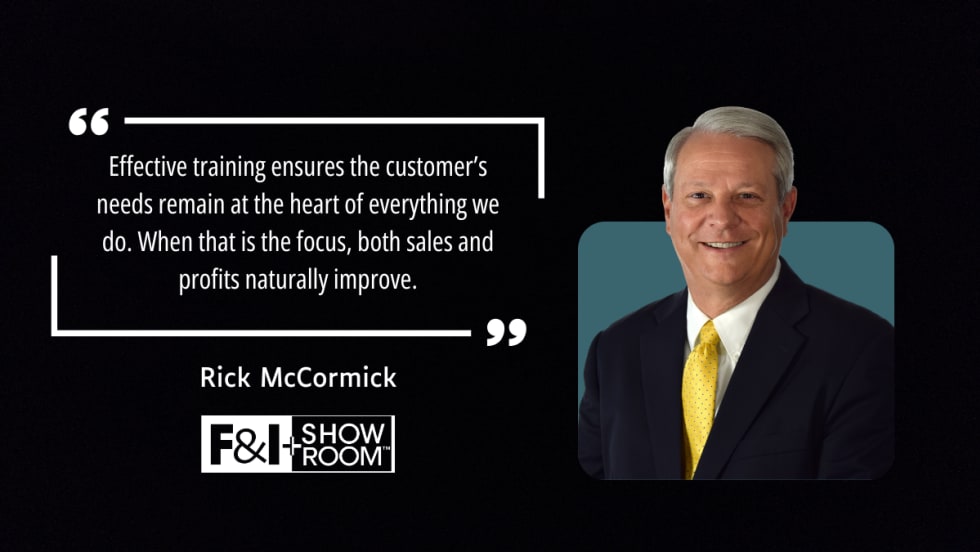
F&I Training Fundamentals
How can auto dealerships help F&I managers fulfill their vital role in the most effective ways? Industry expert Rick McCormick shares his insights on the best ways to train these professionals and help them maintain good habits.
Read More →
Not Just Any Tire Will Do
More consumers and businesses are opting for all-season options for various reasons as safety, sustainability and convenience push practical change.
Read More →