



New Test Ranks EVs' Charge Times
Edmunds says proprietary data, Level 3 measurements pinpoint individual models’ fast-charging speeds.

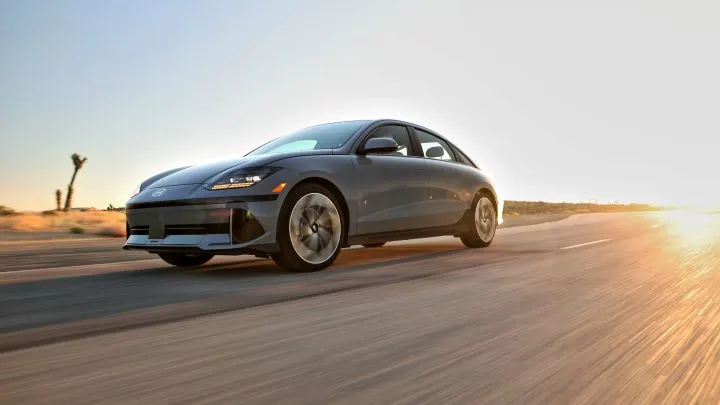
Edmunds says the Hyundai Ioniq 6 tops tested models with an average speed of 868 miles per charging hour, or the equivalent of 100 miles of charge in just under seven minutes.
IMAGE: Hyundai
Edmunds unveiled an electric-vehicle fast-charging test it says shows how quickly an EV model charges.
Charging efficiency is one of a mix of factors prospective EV adopters consider when contemplating a switch from gas-powered models. Gassing up a car takes a fairly predictable amount of time, depending on whether one has to wait to pull up to a pump, but charging speed can vary widely, depending on the model. A recent S&P Global Mobility study found charge speed ranked second only to high price among consumers' reasons for opting out of EV purchases.
Edmunds claims its EV Charging Test independently determines the amount of time it takes an individual model to charge via a fast-charger. It says the evaluation combines Level 3 charging measurements – Level 3 being the fastest charging type – with data from its own efficiency test to arrive at “a new industry standard for electric vehicle charging speeds.”
The company said it tested more than 40 EV models in the inaugural round to arrive at a ranking based on charging speed, putting the Hyundai Ioniq 6 sedan at the top with an average speed of 868 miles per charging hour, or the equivalent of 100 miles of charge in just under seven minutes. At the bottom of the list is the Chevrolet Bolt EUV at 172 miles per charging hour.
Along with the Ioniq 6, top charging performers are the Kia EV6 crossover sports-utility vehicle and the Porsche Taycan sports car, Edmunds said, pointing out that optimum charging efficiency isn’t reserved to luxury models.
Edmunds says the test can hold vehicle makers accountable about charging speeds.
"For too long, automakers have been able to pick and choose, without scrutiny, charging data in order to highlight the best attributes of their vehicles," said Editor-in-Chief Alistair Weaver, who in a press release called the test “an industry benchmark that allows car shoppers to compare charging speeds based on real-world testing and empirical data."
Federal prosecutors are reportedly investigating whether Tesla exaggerated its models’ range between charges after an August Reuters report said the U.S. EV market leader overstated ranges in advertisements and vehicle range meters.
The Edmunds test’s miles per charging hour indicates average charging speeds when charging from 10% to 80%, also expressed as the average time needed to achieve 100 miles of charge. Also included in results are average charging power, peak charging power, charging losses and consumption.
Originally posted on Auto Dealer Today
More Showroom

New Cars Less Affordable
Buying conditions eroded for American shoppers last month due to inflation and interest rates, though they fared better than a year ago.

October Sales Divided
Inventory trends split between the new- and used-vehicle markets, though prices continued to rise for both in October.

Auto Transaction Prices Hit New Height
October sales of big, pricey models push up the average, even as budget-conscious consumers snag more economical options.

Making the Safe Choice
Kelley Blue Book has turned households with teen drivers onto safe and affordable options for their vehicles of choice

Inventory Holds Steady
September new-vehicle inventory rose slightly month-over-month, but dealer lots are laden with MY2026 vehicles as the typical model year changeover trudges along.

October Auto Sales Fall With the Leaves
A forecast anticipates retail deliveries are down this month as consumers continue to face cost challenges, though more are tapping long loans in order to buy.

California Sees Quarterly Gains
California’s new-vehicle market saw a boost in hybrids in the third quarter and its first overall quarterly market gain of the year.

New-Vehicle Prices Stay Put
Affordability pressures and model availability shaped new-vehicle sales in September, according to an analysis by Kelley Blue Book.

EV Buyer Consideration Shifts
What drives American consumers to purchase an electric vehicle is shifting as the question moves away from Should I?' to 'Which features and experience do I want to have?'

Year-to-Date Auto Sales Holding Their Own
A forecast through August shows that automakers have shifted strategies to keep deliveries and revenues up despite tariffs and other economic challenges.