



Polk: Leasing on the Comeback Trail
Automotive leasing represented nearly 19 percent of overall vehicle transactions last year, according to Polk. This represents a 5.8 percentage point increase over 2009 leasing penetration rates.
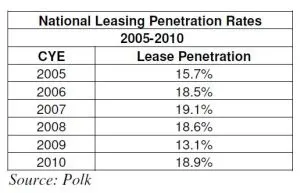
SOUTHFIELD, Mich. – Automotive leasing represented nearly 19 percent of overall vehicle transactions last year, according to Polk. This represents a 5.8 percentage point increase from the 13.1 percent rate tracked in 2009, the year the economic crisis took hold and forced several OEMs to pull back from leasing (See Table A).
“OEMs began to increase their leasing activities in 2010, and consumers have increased confidence in the market and in turn are beginning to lease vehicles again,” said Stephan Gallon, PolkInsight Advisor.
Regional Leasing Trends Show Gains
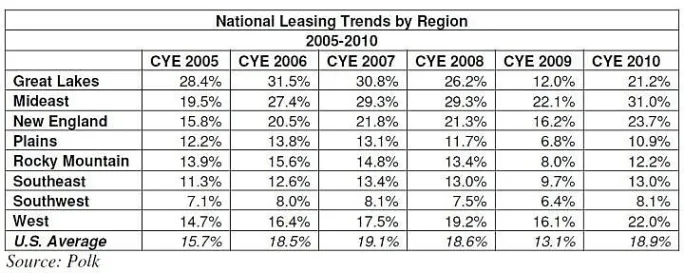
Although leasing increased in all parts of the country in 2010, the growth was not uniformly distributed among regions. Leasing penetration in the Great Lakes region, which was the country’s highest prior to 2007, was only slightly above the industry average in 2010 with 21.2 percent. Nevertheless, as domestic OEMs with a significant presence in the region came back to leasing, the Great Lakes region recorded the highest growth year-over-year among all regions at +9.2 points.
In the Mideast states, lease penetration recorded the second highest year-over-year growth, and reached its highest level in more than six years at 31 percent. New England and the Western region of the country also achieved their highest levels in the past six years. Lease penetration in the Southwest region continued to be the country’s lowest recording the slowest growth at only +1.7 points (See Table B).
Minivan Segment Shows Largest Increase in Leasing Rate
The trend in leasing variations also continued across vehicle segments. Leasing has historically been low in entry level segments and pickup trucks, and high in luxury segments. In 2009, the segments posting the largest lease penetration drop were SUVs and minivans, segments in which domestic OEMs are traditionally strong. For 2010, the segments recording the highest increase in lease penetration were minivans, which recovered from their pre-crisis levels. Also increasing were entry level segments (Basic Economy), where lease penetration gained 10 points year-over-year.
Top Luxury Brands
Mercedes-Benz and BMW remain the top two luxury brands with the highest leasing penetration rates, each garnering more than 50 percent lease penetration rates in 2010. Cadillac progressively increased leasing in the fall of 2009, from below five percent in July 2009 to above 30 percent in December 2010. Conversely, Volvo’s leasing penetration dramatically declined, from 30-40 percent in early 2009 to about 10 percent in late 2010.
“According to recent reports, Volvo stated they were prioritizing margin over volume in 2010, but are planning to increase advertising this year,” said Gallon. “Further reports indicate that Volvo is planning to raise the lease rate to 20-30 percent this year. Volvo and its new owners noted they are adjusting their strategy as the U.S. market is beginning to rebound and new products will allow them to offer more competitive leasing options.”
Leasing Trends by OEM
2010 marked a progressive return to leasing by Chrysler, General Motors and Ford, though lease penetration rates for each were well below previous levels. While the Asian brands remained more active with leasing than the traditional domestics in 2009, they also increased their leasing activities in 2010. Honda led the Asian brands with the highest lease penetration rate at 30 percent, and Hyundai and Toyota improved their penetration rates as well.
More F&I

AI: Facilitator, Not Fixer, in F&I
The dealerships that thrive in the years ahead will be those that embrace technology while continuing to invest in the people who make customer interactions count.
Read More →
Modern Technology Objection Handling
In this video, Trent White shares how to confidently handle technology-based objections by helping customers understand the value of protection, even with modern vehicle technology.
Read More →
Consistency at Scale: Driving F&I Performance
With 75 rooftops across the Sunshine State, Morgan Auto Group has proven to Floridians that it knows a thing or two about driving performance in a competitive market. But it didn’t start at the top.
Read More →
Gitty Up on GAP
The foundational finance-and-insurance product hasn’t kept up with the latest conditions for auto dealers. Is the time ripe?
Read More →
How AI-Powered Coaching Is Transforming F&I Performance
See how AI-powered coaching can turn F&I customer conversations into actionable insights that support compliance, performance and profitability
Read More →
Sell Value, Build Trust
In this video, Trent White explains why selling on value, not fear, builds lasting customer trust, reduces cancellations, and drives long-term success.
Read More →
F&I Sales Give Dealers First-Half Lift
Product business shored up total profits to avoid an overall revenue tanking as product penetrations held steady, StoneEagle reported.
Read More →
Targeted Training Drives Results
Today’s technology, instead of threatening F&I managers, can actually make them better, according to an industry veteran who’s watched market setbacks roil the unprepared.
Read More →
Double the Change, Double the Chance
When an F&I manager gets a customer refusal, it’s a wise move to tweak more than one thing in the product offering.
Read More →
Just Do It
F&I managers need training, but instead of resisting application or expecting perfection, they should improve by simply acting on what they learn.
Read More →