



S&P/Experian: Concerns About Subprime Auto Bubble ‘Seem to Be Behind Us’
Auto loan defaults fell to a 10-year low in May, squashing concerns about a forming subprime auto loan bubble. But not all consumer credit categories were a picture of health in May.
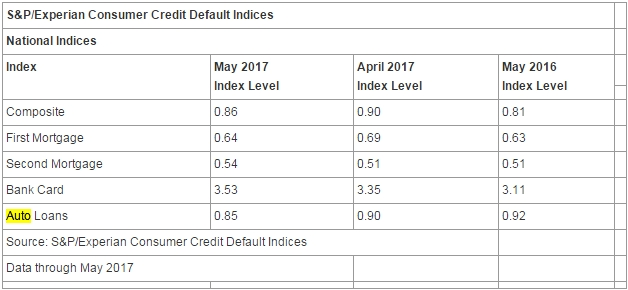
NEW YORK — Concerns about a subprime auto finance crisis are no more, at least according to the S&P/Experian Consumer Credit Default Indices. It showed that default rates for auto loans have drifted down in the last four months, but not all consumer credit categories were a picture of health in May.
The composite rate for consumer credit defaults dropped four basis points from April to 0.86%. By segment, auto loan and first mortgage defaults decreased five basis points each from April to 0.85% and 0.64%, respectively. The bank card default rate, however, increased 13 basis points from April to 3.53% — a 48-month high.
"The pictures of auto loans and mortgages are quite different,” said David M. Blitzer, managing director and chairman of the Index Committee at S&P Dow Jones Indices. “At the beginning of the year there were reports of a sub-prime crisis in auto loans; these concerns seem to be behind us. The first mortgage default rate remains at 1%, lower than the pre-crisis period. Rising home prices and increases in the equity mortgage borrowers have in their home are helping lower default rates.”
Blitzer noted that one factor playing into rising bank card defaults and stable defaults on mortgages and autos are interest rates: about 4% on mortgages and 4.4% on auto loans, compared to 12%-18% on bank card loans.
He added that in the past, default rates began to climb around the same time the growth of bank card credit outstanding began to slow. He noted that year-over-year growth of bank card credit outstanding peaked at 6.8% last November and was at 5.7% in April, the latest figure available. Bank card defaults rose from 2.81% in November to 3.35% in April, and up to 3.53% in May.
When comparing the bank card default rate among the four census divisions, the default rate in the South is considerably higher than the other three census divisions. The East South Central Census Region — comprised of Kentucky, Tennessee, Alabama, and Mississippi — has the highest bank card default rate. As per the Bureau of Labor Statistics, these states have some of the lowest median household income.
"Easy come, easy go: bank cards, where borrowing money requires simply swiping a credit card, are experiencing rising defaults, while defaults on other kinds of consumer credit, which depend on paperwork, are flat or down," said David M. Blitzer, managing director and chairman of the Index Committee at S&P Dow Jones Indices. "Default rates on bank cards are at the highest level since May 2013.”
Overall, four of the five major cities saw their default rates decrease in the month of May. New York experienced the largest decrease, down nine basis points from April to 1.01%. Los Angeles reported a default rate of 0.66% for May, dropping three basis points from the previous month. Dallas came in at 0.67%, down two basis points from April. Miami was down one basis point from April to 1.29%. At 0.97%, Chicago was the only city reporting a default rate increase of three basis points from the previous month.
Jointly developed by S&P Dow Jones Indices and Experian, the S&P/Experian Consumer Credit Default Indices represent a comprehensive measure of changes in consumer credit defaults. They track the default experience of consumer balances in four key loan categories: auto, bankcard, first mortgage lien, and second mortgage lien. For more, visit www.consumercreditindices.standardandpoors.com.
More F&I

AI: Facilitator, Not Fixer, in F&I
The dealerships that thrive in the years ahead will be those that embrace technology while continuing to invest in the people who make customer interactions count.
Read More →
Modern Technology Objection Handling
In this video, Trent White shares how to confidently handle technology-based objections by helping customers understand the value of protection, even with modern vehicle technology.
Read More →
Consistency at Scale: Driving F&I Performance
With 75 rooftops across the Sunshine State, Morgan Auto Group has proven to Floridians that it knows a thing or two about driving performance in a competitive market. But it didn’t start at the top.
Read More →
Gitty Up on GAP
The foundational finance-and-insurance product hasn’t kept up with the latest conditions for auto dealers. Is the time ripe?
Read More →
How AI-Powered Coaching Is Transforming F&I Performance
See how AI-powered coaching can turn F&I customer conversations into actionable insights that support compliance, performance and profitability
Read More →
Sell Value, Build Trust
In this video, Trent White explains why selling on value, not fear, builds lasting customer trust, reduces cancellations, and drives long-term success.
Read More →
F&I Sales Give Dealers First-Half Lift
Product business shored up total profits to avoid an overall revenue tanking as product penetrations held steady, StoneEagle reported.
Read More →
Targeted Training Drives Results
Today’s technology, instead of threatening F&I managers, can actually make them better, according to an industry veteran who’s watched market setbacks roil the unprepared.
Read More →
Double the Change, Double the Chance
When an F&I manager gets a customer refusal, it’s a wise move to tweak more than one thing in the product offering.
Read More →
Just Do It
F&I managers need training, but instead of resisting application or expecting perfection, they should improve by simply acting on what they learn.
Read More →