



Toyota Hydrogen Fuel Cell Project Advances
Less than a year after it produced the first prototype, it’s now testing and marketing 10 Hiluxes in its quest for carbon neutrality.

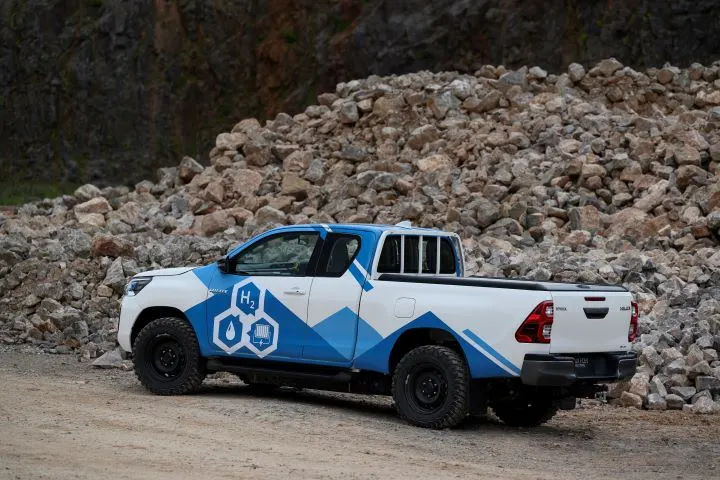
Toyota says the Hilux project 'will contribute to the next generation of fuel cell technology, which will offer longer lifecycles, increased driving range for vehicles and significantly reduced costs.'
Toyota
Toyota entered the demonstration phase of its hydrogen fuel cell project, taking half of 10 Hilux pickup truck prototypes it’s built since last fall into field testing and the other half into customer and media demonstrations.
“By engaging customers with hydrogen fuel cell technology, Toyota is laying the groundwork for a successful hydrogen transport sector in the future,” the Japanese automaker said in a press release.
The demonstration trucks will make appearances at the summer Olympic games in Paris.
Toyota touts the hydrogen-fueled vehicles as a spoke in a wheel of power trains to achieve its goal of carbon neutrality for its lineup “to suit different user needs and local infrastructure.”
The other spokes are hybrid electric, plug-in hybrid electric, battery electric and e-fuels.
The 10 Hilux were built at its Derby, England factory, incorporating what Toyota says is 30 years of hydrogen fuel cell research and development. It says it expects Europe to be one of the biggest commercial markets for hydrogen fuel cell vehicles by 2030.
Toyota says the Hilux project “will contribute to the next generation of fuel cell technology, which will offer longer lifecycles, increased driving range for vehicles and significantly reduced costs.”
The Hilux adapts the emerging power train technology to Toyota’s conventional Hilux truck, first produced in 1968 and introduced to the U.S. market in 1972, replacing it here with the Tacoma in 1995.
DIG DEEPER: Final Fuel-Economy Rule Sets Lower Bar
Originally posted on Auto Dealer Today
More Industry
New-Vehicle Prices Stay Put
Affordability pressures and model availability shaped new-vehicle sales in September, according to an analysis by Kelley Blue Book.
Read More →
EV Buyer Consideration Shifts
What drives American consumers to purchase an electric vehicle is shifting as the question moves away from Should I?' to 'Which features and experience do I want to have?'
Read More →
Auto Nameplate Loyalty Holds in Tough Times
Consumers have been faithful to brands despite financial pressures, and JD Power says that’s because automakers have made some wise moves.
Read More →
Top New Jersey RV Store Sells
Myer’s RV Superstore is expanding its footprint in the state with two new locations that it acquired from Ed Hutchinson Jr.
Read More →
Alliance Analyzes Technician Pipeline
A new industry report examines the state of skilled trades in the U.S. and details the drivers of demand for automotive repair and how technicians enter and grow in the workforce.
Read More →
Luxury Rooftop Changes Hands
Genesis of Glenview is getting a new owner and a new location, but its name will stay the same.
Read More →
Future-Proof Your Business
A new industry outlook details several ways that automotive companies can use the rise in artificial intelligence and advanced technologies to their advantage.
Read More →
Dealership Buy-Sells Keep Going Up
First-half transactions reflect continued high appetite for acquisitions despite falling profits, the most sought-after franchises bringing record prices.
Read More →
California Makes Electric Moves
New laws in the Golden State aim to advance consumer access to public electric-vehicle chargers and reduce costs and barriers to its infrastructure.
Read More →
Rare Earths Independence
Automakers seek alternatives to sourcing battery raw materials in volatile markets roiled by trade wars and disrupted supply chains.
Read More →