



U.S. Auto Sales Fall 5.2% in January; Foreign Firms Gain Market Share
U.S. auto sales fell 5.2 percent in January compared to a year ago, as Asian and European auto makers continued to pound General Motors Corp., Ford Motor Co., and DaimlerChrysler AG, driving market share for the Big Three below 60 percent for the month, according to a Wall Street Journal story by Sholnn Freeman.
But on a brighter note for the industry, auto sales beat the projections of analysts who foresaw a sharper slowdown in the month, on the assumption that zero percent financing incentives pulled ahead hundreds of thousands of sales late last year.
In January 2002, new car and truck sales totaled 1,111,887 vehicles, down from 1,172,871 vehicles in January 2001. The results translated into a seasonally adjusted annual rate of 15.8 million vehicles for the month.
GM said sales fell 13 percent to 295,700 vehicles from January 2001. Sales at Ford dropped 10 percent, and DaimlerChrysler's Chrysler Group brands suffered a 6.8 percent decline.
Japan's Toyota Motor Corp.'s U.S. sales climbed 7.1 percent compared with a year ago, while Honda Motor Co.'s sales fell 1.5 percent. Volkswagen AG's sales increased 5.2 percent. At Mitsubishi Motor Corp., which had aggressive
incentives in place, sales rocketed 20 percent. BMW AG increased sales of its luxury cars and sport utility vehicles by 16 percent. Korea's Hyundai Motor Co. outsold GM's Pontiac division, 27,126 vehicles to 25,212.
Collectively, the Big Three's share of the U.S. market was 59.2 percent in January, a loss of 4.5 percentage points from the month a year ago. Japanese makers added 2.3 points of share to nearly 30 percent of the market as they
continue to move into trucks and SUVs.
European and Korean manufacturers each picked up about one point of share for their respective groups. Their total gain in share was equivalent to about 48,000 vehicles in January.
More F&I

Why Your F&I PVR Is Misleading You
Here’s a handy checklist of the numbers to track in 2026 instead.
Read More →
Auto Consumer Anxiety Presents Opportunity
A survey of U.S. drivers found the majority are concerned about finances and the economy, but those fears make many ready to buy vehicle-protection products.
Read More →
Humble and Hungry: 12 Rules for an F&I Life
Dustin Gingerich, with a decade in the F&I business under his belt, shares his thoughts on leadership, building trust with customers, and the importance of learning and innovation.
Read More →
Focus on the Opening
F&I managers must learn as much as possible about their customers, starting before they walk into their offices. The bulk of today’s consumers expect that, and good results will follow.
Read More →
F&I Reaches for the Sky
The increasingly important profit center continued making gains in the first quarter, according to StoneEagle data, ancillary products proving more popular as consumers hold onto their buys longer.
Read More →
Timing the Market Can Hurt Long-Term Program Performance
For dealer-owned reinsurance entities, avoiding volatility entirely can mean falling behind inflation and missing market rebounds that drive long term surplus growth. Missing just a handful of strong market days can materially impact cumulative returns—an important reminder for long horizon trust and investment strategies.
Read More →
The 90/10 Rule
In this video, Ryan Ruff explains the rule that elite sales professionals use to turn ordinary conversations into unforgettable customer experiences.
Read More →
Your Office Is Talking
What’s the atmosphere saying about you to your customers? You can make minor adjustments and additions that transform your space into one that creates trust with the people on the other side of the desk.
Read More →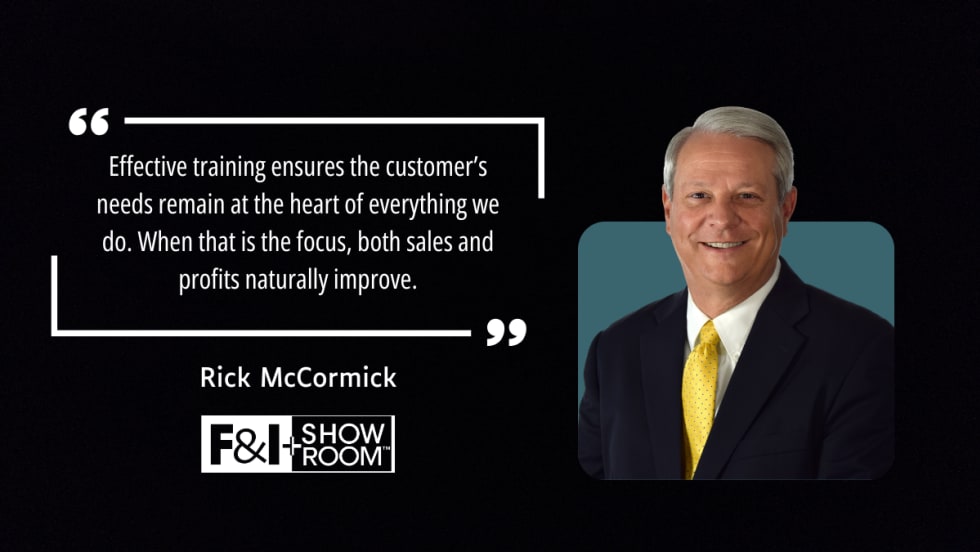
F&I Training Fundamentals
How can auto dealerships help F&I managers fulfill their vital role in the most effective ways? Industry expert Rick McCormick shares his insights on the best ways to train these professionals and help them maintain good habits.
Read More →
Not Just Any Tire Will Do
More consumers and businesses are opting for all-season options for various reasons as safety, sustainability and convenience push practical change.
Read More →