



Consumers Want Price Transparency From Service Centers, Survey Finds
Price uncertainty is the No. 1 reason a customer won’t visit a dealership’s service center for maintenance, according to results of a survey commissioned by Record360.
SEATTLE — Price uncertainty is the No. 1 reason a customer won’t visit a dealership’s service center for maintenance, according to results of a survey commissioned by Record360, which provides asset condition reporting app.
If dealerships want to bring those weary customers in and improve customer retention, then their pricing needs to be transparent and they need to provide greater visibility into vehicle condition, results of the survey concluded.
“It’s exciting to see that customers are asking for services that are well within any dealership’s ability to offer. Whether it’s stronger transparency around cost and the time it takes to complete maintenance or around visualizing vehicle condition, customers are asking for things that dealerships can implement right now, or with some minor technology upgrades,” said Shane Skinner, co-founder and CEO of Record360.
More than half of respondents said they wanted a free car wash as part of their visit. About 41% stated they wanted an email record of their vehicle’s condition.
One thing that would dissuade a majority of survey respondents from ever returning to a dealership was stolen property, the survey found. Eighty percent of respondents said they would not return to a service center if they thought an item went missing from their car during their last visit.
The survey polled 500 consumers that had taken their vehicle into a dealership service center for maintenance within the past 12 months. Respondents were asked about the factors that determine whether or not they’ll visit a dealership’s service center, as well as what kind of services they would want to see from their service centers.
More F&I

Why Your F&I PVR Is Misleading You
Here’s a handy checklist of the numbers to track in 2026 instead.
Read More →
Auto Consumer Anxiety Presents Opportunity
A survey of U.S. drivers found the majority are concerned about finances and the economy, but those fears make many ready to buy vehicle-protection products.
Read More →
Humble and Hungry: 12 Rules for an F&I Life
Dustin Gingerich, with a decade in the F&I business under his belt, shares his thoughts on leadership, building trust with customers, and the importance of learning and innovation.
Read More →
Focus on the Opening
F&I managers must learn as much as possible about their customers, starting before they walk into their offices. The bulk of today’s consumers expect that, and good results will follow.
Read More →
F&I Reaches for the Sky
The increasingly important profit center continued making gains in the first quarter, according to StoneEagle data, ancillary products proving more popular as consumers hold onto their buys longer.
Read More →
Timing the Market Can Hurt Long-Term Program Performance
For dealer-owned reinsurance entities, avoiding volatility entirely can mean falling behind inflation and missing market rebounds that drive long term surplus growth. Missing just a handful of strong market days can materially impact cumulative returns—an important reminder for long horizon trust and investment strategies.
Read More →
The 90/10 Rule
In this video, Ryan Ruff explains the rule that elite sales professionals use to turn ordinary conversations into unforgettable customer experiences.
Read More →
Your Office Is Talking
What’s the atmosphere saying about you to your customers? You can make minor adjustments and additions that transform your space into one that creates trust with the people on the other side of the desk.
Read More →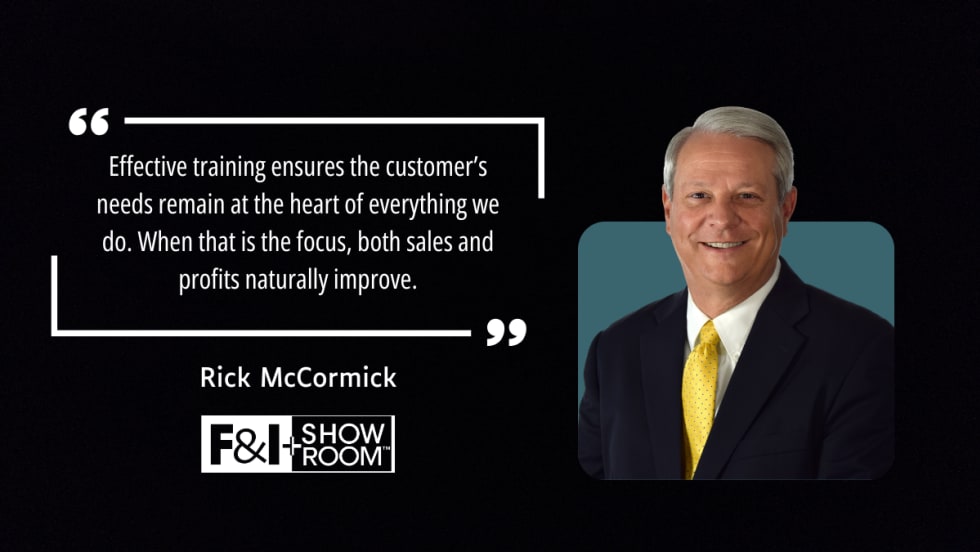
F&I Training Fundamentals
How can auto dealerships help F&I managers fulfill their vital role in the most effective ways? Industry expert Rick McCormick shares his insights on the best ways to train these professionals and help them maintain good habits.
Read More →
Not Just Any Tire Will Do
More consumers and businesses are opting for all-season options for various reasons as safety, sustainability and convenience push practical change.
Read More →