



California Leading
Though the state’s auto dealers haven’t sought to be ahead of some industry curves, its unique regulatory environment has forced that over the past century.

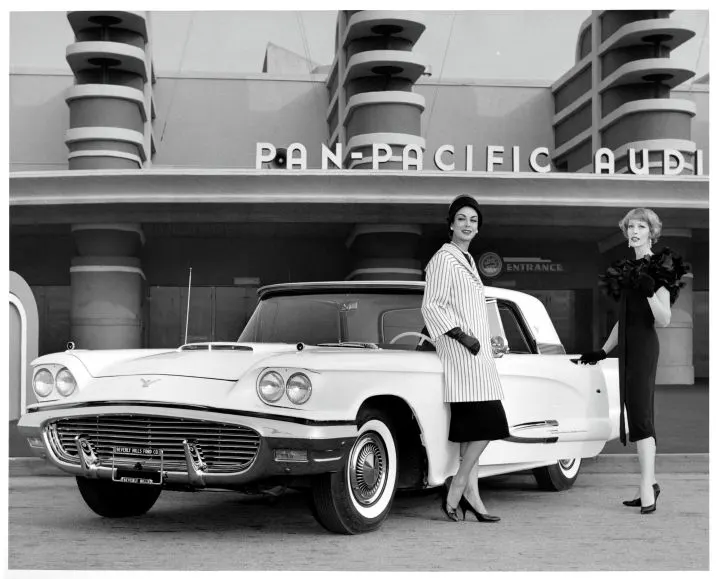
Models outside the 1958 Los Angeles Auto Show at the Pan Pacific Auditorium
Seaver Center for Western History Research
In December, near the end of its 100th year, the California New Car Dealers Association issued a cease-and-desist order challenging Volkswagen and its Scout division for selling vehicles directly to consumers.
Though a group of Florida Volkswagen and Audi dealers followed with a lawsuit against Scout in February, California’s order was the first official pushback against the sales model, which has riled the auto retail sector across the country because it shuts dealers out of the process.
The automaker refused to comply with CNCDA’s order, and the group is discussing its options.
It certainly wasn’t the first time the association has stepped out to take the lead on an industry issue that affects its members’ cohorts in other states. In fact, the Golden State group is known for that and for other firsts that often influence other states’ dealer groups and therefore help change the sector, especially in the area of compliance.
Though the group’s priority must be its own dealer members, it takes its influential role seriously because it knows some moves it makes will ripple across the country as much as do street slang and fashions.
The reason California’s auto retail sector often finds itself ahead of the curve is simply because the state is highly regulated, and car sales are by no means an exception. Some in the industry lament that for that very reason it can be hard to break into the California market.
“We focus on educating our dealers on what the rules of the road are, literally, how they have to operate their businesses, how they conduct themselves with customers,” said CNCDA’s president for the past 12 years, Brian Maas, who joined the group in 2002 as counsel and lobbyist.
“Because we tend to see issues first, how we react to those issues tends to set the tone for how many other states react.”
Power in Numbers
The group made a concerted effort over the past decade to increase its membership from the 8,000 dealerships range, and about 85% of California’s 1,400 franchised dealers are now members, making it the biggest dealer association in the country for another outsized role in the industry.
It has leveraged its numbers to secure concessions from automakers that make the state’s franchise law one of the strongest in the country, says Maas, who puts protection of that law at the top of the group’s priorities list, hence the order to Scout.
“For 100 years the franchise model has proven to be the best model to sell vehicles in the U.S.,” Maas says. “Ultimately manufacturers, if they’re going to be mass-market brands, are going to have to agree with that … Our law makes clear that manufacturers can’t compete with their own franchise.”
The association has also garnered other protections when it comes to automakers. In 2019 and 2023 CNCDA efforts led to California updating its auto dealer franchise laws to guarantee auto dealers get retail labor rates for warranty and recall repairs done on behalf of automakers, a protection not all states have in place.
CNCDA also closely follows proposed state regulations affecting its dealers, Maas tapping his specialty of political law to guide negotiations with lawmakers.
An example is California’s Car Buyer’s Bill of Rights, which the state legislature passed in 2006. The law established a precontract disclosure statement providing auto consumers with the monthly cost of their vehicle purchases with and without add-ons for comparison purposes.
The final law satisfied dealers by incorporating compromises CNCDA negotiated, including an extra charge for an optional two-day return policy for new vehicles instead of the originally proposed three-day return policy at no cost to the consumer. Other sections of the original bill were abandoned during the negotiation process.
“They had all kinds things about financing, etc.,” Maas says. “We wanted to make sure that the final result was easy enough for dealers to implement.”
The Federal Trade Commission borrowed one of the law’s main provisions for its proposed CARS Rule intended to protect consumers from deceptive and unfair practices in car sales and leasing, though Maas considers the FTC measure “more onerous” in many ways. In any case, a federal appeals court recently scuttled the proposal, much to auto retailers’ relief.
The California regulation, though, ended up being a “successful policy” for auto retail in the state, Maas says.
Learning, Too
CNCDA also borrows from other states, often as Maas attends meetings with his counterparts across the country for Automotive Trade Association Executives events. “There’s a trade association for everything,” he jokes.
The executives share best practices, trends they see emerging in their state legislatures, and ideas on how to counter some automakers’ practices that might not serve auto retail well.
“A few years ago there was big concern when privacy laws start kicking in about whether or not manufacturers and other groups were going to have access to dealer data that they shouldn’t have,” Maas recalls. “So many states started enacting data-protection laws, and we shared ideas.”
An Arizona state law ended up becoming the industry standard and was upheld by a federal appellate court. A dealer must now grant permission to a vendor to access its data.
“The main thrust is that the dealer has the relationship with the customer and has to be the one to give the permission,” Maas says.
Possible Future Precedents
At the top of CNCDA’s priority list is an emissions issue that affects all automakers that sell vehicles in California, a mandate that could spread throughout the U.S. due to the state’s historical policy-making influence.
The group aims to convince the California Air Resources Board to pause its mandate that all new-vehicle sales in the state be zero-emission models by 2035. None of the automakers it represents are prepared to meet the deadline, Maas says.
“We need CARB to take a second look at the rule and make adjustments. We’ll be asking in coming weeks for CARB to pause it till we figure out what a reasonable solution for California drivers and dealers.”
How the regulation pans out may have wider repercussions because 11 other states have already adopted similar versions of it. Meanwhile, CNCDA will support the national auto dealers association in its stance on federal emissions rules in place since the 1970s energy crisis that the new Trump administration has moved to reverse.
Meanwhile, like other states, California is grappling with an industrywide technician shortage, and CNCDA has begun a concerted effort to help replenish the crucial workforce segment.
The group has built strong relationships with state legislators “to try to protect the future of our industry,” said this year’s chairman, Robb Hernandez, dealer operator of Camino Real Chevrolet in Monterey Park in the San Gabriel Valley of Los Angeles County, by far the state’s most populous county and the center of its car culture.
Hernandez, whose father, Mike, started the dealership in 1976, is working alongside his siblings and three other generations of the family. He says it’s important for CNCDA to help consumers appreciate the innovation dealers have brought to the industry to help keep auto retail strong.
Revisiting the state emissions regulation is an important step in that effort for both dealers and consumers, he says.
“We all want clean air and a clean environment, but we think some of the targets need to be more realistic … We need to come up with some realistic regulation, and hopefully over time that will start building demand versus trying to force it.”
Regardless of the issue dealers anywhere in the country face, forging the most successful path should involve a strong state dealer association, according to Maas, though he recognizes the reality that some dealers will choose to go it alone.
“It’s about engagement. It’s about engaging your dealers to understand what problems they have relative to the manufacturer and laws,” Maas says. “We work to make it better every day.”
Hannah Mitchell is executive editor of F&I and Showroom. A former daily newspaper journalist, she honed her craft covering politics, business and more for publications that included the Charlotte Observer and the Orange County (Calif.) Business Journal. She holds a master’s degree in journalism from Columbia University, and her first car was a hand-me-down Chevrolet Nova.
More Industry
Connection Drives Consideration
Convenience and safety are top priorities for American drivers when it comes to connected vehicles and the services they expect with their next car.
Read More →
New-Vehicle Prices Stay Put
Affordability pressures and model availability shaped new-vehicle sales in September, according to an analysis by Kelley Blue Book.
Read More →
EV Buyer Consideration Shifts
What drives American consumers to purchase an electric vehicle is shifting as the question moves away from Should I?' to 'Which features and experience do I want to have?'
Read More →
Auto Nameplate Loyalty Holds in Tough Times
Consumers have been faithful to brands despite financial pressures, and JD Power says that’s because automakers have made some wise moves.
Read More →
Top New Jersey RV Store Sells
Myer’s RV Superstore is expanding its footprint in the state with two new locations that it acquired from Ed Hutchinson Jr.
Read More →
Alliance Analyzes Technician Pipeline
A new industry report examines the state of skilled trades in the U.S. and details the drivers of demand for automotive repair and how technicians enter and grow in the workforce.
Read More →
Luxury Rooftop Changes Hands
Genesis of Glenview is getting a new owner and a new location, but its name will stay the same.
Read More →
Future-Proof Your Business
A new industry outlook details several ways that automotive companies can use the rise in artificial intelligence and advanced technologies to their advantage.
Read More →
Dealership Buy-Sells Keep Going Up
First-half transactions reflect continued high appetite for acquisitions despite falling profits, the most sought-after franchises bringing record prices.
Read More →
California Makes Electric Moves
New laws in the Golden State aim to advance consumer access to public electric-vehicle chargers and reduce costs and barriers to its infrastructure.
Read More →