



4 Social Media Landmines
Dealership expert identifies four common landmines dealers run into when marketing on social media, and offers recommendations for staying out of the crosshairs of regulators.

Photo courtesy of iStock.
With more than one billion people on Facebook, more than 400 million on LinkedIn and a little more than 300 million on Twitter, social media has become an essential and inescapable part of everyday life. Sheer volume is one of the reasons it has become a key marketing channel for dealers looking to pick up additional sales.
Marketing on social media, however, also presents some legal and compliance challenges. It can also become a public relations nightmare, as a Massachusetts dealer discovered in January 2015 after his employees posted a video on YouTube in which they belittle a pizza delivery man. And as dealers and other marketers nationwide are learning, the Consumer Financial Protection Bureau (CFPB) and Federal Trade Commission (FTC) are reviewing ads, investigating complaints and issuing fines for violations of the Truth in Lending Act and the FTC Act.
Ads posted on social media are no exception. Last May, the FTC updated its Endorsements Guides for the first time since 2010, adding new guidelines specifically for marketers offering social media contests and online endorsements or review programs.
Inadvertent Deception
The attention social media is getting from regulators was the subject of a workshop led by Rich Moore this past November at Texas Compliance Summit. After explaining why dealers can’t afford not to be on social media, the director of training for Protective Asset Protection said dealers are setting themselves up by not giving their social media ads the same compliance review they give their traditional advertisements.
“How many of you are at a dealership or advise a dealership that markets on [social media]?” Moore asked. “I’m going to bet that 80% or better of those dealerships have set themselves up. Remember when I talked about how we never try to be purposely deceptive, but being inadvertently deceptive can get us in trouble? That’s the way it happens.”
The following are four common social media issues Moore has observed, along with his advice on how to avoid legal troubles:
1. Treat Social Media Ads Like Traditional Advertisements
What some dealers fail to understand is the same regulators who oversee traditional advertisements also regulate online advertisements, and they are subject to the same level of scrutiny. Moore advises dealers to treat their next social media post with the same strict compliance standards they would apply if it were a banner ad on a website or in their local newspaper.
“The Sunday ad,” Moore said, as a newspaper ad appeared on the screen behind him. “‘Buy this today for $99 down and $132 a month.’ What’s really close to those big letters about what you can buy? The fine print, the mouse type. That was great when we were running a full-page Sunday ad and we had all the room. But you don’t have that much room when you get down to a five-inch [phone] screen,” Moore said.
The simple rule is that any advertisement containing pricing information or payment estimates must have a disclosure, Moore explained. And that disclosure needs to be viewable on the same page as the advertisement. If a visitor needs to scroll down in order to see the disclosure, then that advertisement is not compliant with FTC regulations. That means the web page needs to be reformatted in order to fit the advertisement and disclosures without requiring the need to scroll.
2. Informing Employees about Policies
The easiest way for dealers to avoid compliance issues is to only release advertisements containing pricing information on the dealership’s official page. In other words, these ads should not originate from an employee’s personal social media account.
The employee may be genuinely excited about a great vehicle that was just marked down. But without proper training or information, they may inadvertently release a post that runs afoul of FTC regulations, Moore said. He advises dealers to establish a social media policy and distribute it to all employees to help prevent a well-meaning act from costing the dealership.
3. Prices and Payments in Less Than 140 Characters
Twitter’s character limit doesn’t leave dealers with a lot of space to work with, and attempting to jam all the necessary disclosures into so little space can open the dealership up to serious compliance issues.
Moore offered examples of tweets that would and would not pass muster:
Good Tweet: “Used 2007 Cadillac DTS Luxury. Two in San Antonio for sale at ABC Motors.”
Bad Tweet: “Used 2010 BMW 3 Series 328i $27,400. Payments $279 a month.”
The first tweet requires no disclosures; it simply tells readers where they can purchase the vehicle. The second tweet, however, includes the price of the vehicle and the estimated monthly payment. Problem is, it doesn’t disclose what that $27,400 price includes or how to secure that $279 payment.
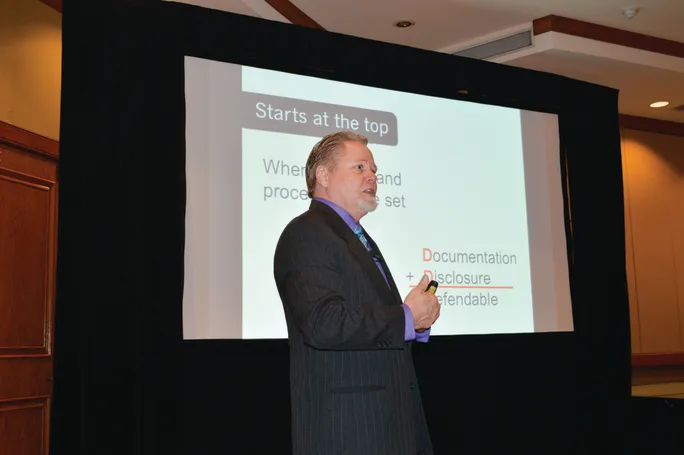
The attention social media is getting from regulators was the subject of a workshop led by Rich Moore this past November at Texas Compliance Summit. The director of training for Protective Asset Protection said dealers are setting themselves up by not giving their social media ads the same compliance review they give their traditional advertisements.
Even if the dealer wanted to add those disclosures, Twitter doesn’t provide much room to work with. The better route is to not include such specific information about the vehicle, Moore said, then provide a link that directs shoppers to a landing page that contains all the disclosures pertinent to the offer.
4. The Danger of Reposts
The fact that anyone can repost or share a dealership’s social media messages presents yet another danger for dealers. The more eyes, the better; but if an ad doesn’t follow proper disclosure guidelines, sharing the noncompliant ad increases the chances it will be seen by the FTC.
And as Moore pointed out, sharing ads can sometimes cut off disclosures the dealer added to the original post. And unfortunately, regulators don’t care whether the dealer got it right before the post was shared. So, again, keeping posts simple and creating landing pages containing prices, payments and all the proper disclosure may be the right way to go.
Dealers should not be afraid to try a new medium, Moore said, but you have to work within its limitations. “So this is what I want you to start thinking about and this is what you can take back to your dealerships: Think about the medium and think about how you get the disclosures in there.”
More F&I

AI: Facilitator, Not Fixer, in F&I
The dealerships that thrive in the years ahead will be those that embrace technology while continuing to invest in the people who make customer interactions count.
Read More →
Modern Technology Objection Handling
In this video, Trent White shares how to confidently handle technology-based objections by helping customers understand the value of protection, even with modern vehicle technology.
Read More →
Consistency at Scale: Driving F&I Performance
With 75 rooftops across the Sunshine State, Morgan Auto Group has proven to Floridians that it knows a thing or two about driving performance in a competitive market. But it didn’t start at the top.
Read More →
Gitty Up on GAP
The foundational finance-and-insurance product hasn’t kept up with the latest conditions for auto dealers. Is the time ripe?
Read More →
How AI-Powered Coaching Is Transforming F&I Performance
See how AI-powered coaching can turn F&I customer conversations into actionable insights that support compliance, performance and profitability
Read More →
Sell Value, Build Trust
In this video, Trent White explains why selling on value, not fear, builds lasting customer trust, reduces cancellations, and drives long-term success.
Read More →
F&I Sales Give Dealers First-Half Lift
Product business shored up total profits to avoid an overall revenue tanking as product penetrations held steady, StoneEagle reported.
Read More →
Targeted Training Drives Results
Today’s technology, instead of threatening F&I managers, can actually make them better, according to an industry veteran who’s watched market setbacks roil the unprepared.
Read More →
Double the Change, Double the Chance
When an F&I manager gets a customer refusal, it’s a wise move to tweak more than one thing in the product offering.
Read More →
Just Do It
F&I managers need training, but instead of resisting application or expecting perfection, they should improve by simply acting on what they learn.
Read More →