



Consumers Still Keeping Cars Longer
The percentage of older vehicles on the road has reached its highest level since 2009, and the average age of vehicles on the road is expected to keep rising.

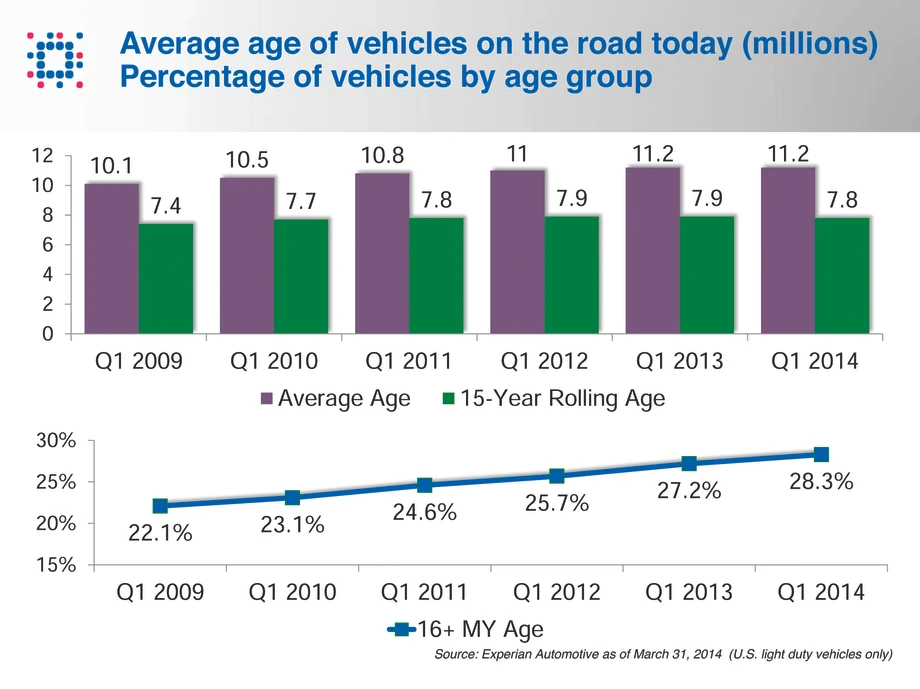
Dealers hoping to shorten consumer buying cycles may have to wait, as recent data from Experian Automotive and IHS Automotive show that consumers are still holding onto their cars. In fact, the percentage of older vehicles on the road has reached its highest level since 2009.
According to Experian’s most recent Automotive Market Trends analysis, vehicles predating the 2001 model year made up more than 28.3% of all vehicles on the road during the opening quarter of 2014, up from 22.1% six years earlier. The top model-year 2000 and older vehicles driven by consumers include the Ford F-150, Chevrolet Silverado 1500, Honda Accord, Toyota Camry, Ford Ranger and Honda Civic.
Experian’s findings mirror stats released by IHS Automotive in early June, which showed that the combined average age of all light vehicles on the road in the United States is 11.4 years — a count the firm predicts will remain steady through 2015. By 2017, however, that number is expected to grow to 11.5 years, and then to 11.7 years by 2019.
“In our history of tracking, we have seen a gradual increase in the average age of vehicles on the road,” said Mark Seng, director of aftermarket solutions and global aftermarket practice leader at IHS Automotive. “This year, we’re seeing somewhat of a plateau in the market, and we expect it to remain over the next few years … We attribute this to a number of factors, including the economy and the increasing quality of today’s automobiles.”
The improved quality of automobiles, officials said, has contributed to consumers holding onto their vehicles longer, with the percentage of vehicles on the road that are 12 years or older continuing to grow. The firm said it expects the percentage of vehicles on the road that are 12 years of age and older will increase 15% by 2019.
On a positive note, this rate of growth in the average age of vehicles on the road appears to be slowing vs. the previous five years. The firm attributed the slowing pace to the substantial increase in new-vehicle sales. In fact, IHS Automotive forecasts that the volume of vehicles that are zero-to-five years old will increase by 32% over the next five years, while vehicles between six and 11 years old will decline by 21%.
“Auto companies have been seeing the benefits from consumers coming back to market due to pent-up demand following the recession. However, it’s clear that more and more consumers continue to drive older model vehicles,” said Melinda Zabritski, Experian Automotive’s senior director of automotive credit. “While the growth in early model vehicles on the road is slowing, getting the most out of the vehicle they purchase still appears to be top of mind for consumers.”
More F&I

AI: Facilitator, Not Fixer, in F&I
The dealerships that thrive in the years ahead will be those that embrace technology while continuing to invest in the people who make customer interactions count.
Read More →
Modern Technology Objection Handling
In this video, Trent White shares how to confidently handle technology-based objections by helping customers understand the value of protection, even with modern vehicle technology.
Read More →
Consistency at Scale: Driving F&I Performance
With 75 rooftops across the Sunshine State, Morgan Auto Group has proven to Floridians that it knows a thing or two about driving performance in a competitive market. But it didn’t start at the top.
Read More →
Gitty Up on GAP
The foundational finance-and-insurance product hasn’t kept up with the latest conditions for auto dealers. Is the time ripe?
Read More →
How AI-Powered Coaching Is Transforming F&I Performance
See how AI-powered coaching can turn F&I customer conversations into actionable insights that support compliance, performance and profitability
Read More →
Sell Value, Build Trust
In this video, Trent White explains why selling on value, not fear, builds lasting customer trust, reduces cancellations, and drives long-term success.
Read More →
F&I Sales Give Dealers First-Half Lift
Product business shored up total profits to avoid an overall revenue tanking as product penetrations held steady, StoneEagle reported.
Read More →
Targeted Training Drives Results
Today’s technology, instead of threatening F&I managers, can actually make them better, according to an industry veteran who’s watched market setbacks roil the unprepared.
Read More →
Double the Change, Double the Chance
When an F&I manager gets a customer refusal, it’s a wise move to tweak more than one thing in the product offering.
Read More →
Just Do It
F&I managers need training, but instead of resisting application or expecting perfection, they should improve by simply acting on what they learn.
Read More →