



Deciphering the Terms
Terms like ‘prescreen’ and ‘prequalification’ may seem similar, but they’re not. An executive for a credit report reseller issues a warning to dealers considering the new wave of ‘soft pull’ systems.

Darin Larsen is the COO and owner of Credit Bureau Connection, an authorized credit report reseller for the credit repositories Equifax, Experian and Transunion. Soft pull technology has become a hot topic in the automotive industry and he says that much of that can be attributed to the growing level of awareness consumers have of their credit rating.
Software systems designed to help dealers determine a customer’s buying power without a Social Security number were a hot item at last month’s National Automobile Dealers Association (NADA) convention. But an executive for one provider has a warning for dealers considering one of these “soft pull” systems.
Darin Larsen, COO and owner of Credit Bureau Connection (CBC), says while some providers use “prescreen” and “prequalify” interchangeably, the terms actually have specific definitions tied to them. Credit repositories like Equifax, Experian and Transunion also have specific requirements for each product. Failure to abide by them, Larsen adds, can result in a dealer losing access to consumer credit reports. Dealers can also subject themselves to potential lawsuits.
Fresno, Calif.-based CBC opened its doors in 2004 as an authorized reseller of credit reports for the three main credit repositories. New compliance requirements imposed on dealers in recent years, however, led the company to add compliance solutions and other services to its arsenal.
The firm is now integrated into aftermarket provider networks, CRM systems, Desking and DMS systems as well as credit platforms such as Dealertrack, and RouteOne. It not only aims to sell products but also to educate its customers about the different solutions available.
F&I: Can you explain the differences between some of the terms associated with credit reports?
Larsen: Yes, certain terms get thrown around very loosely. But as a reseller [of credit reports] working closely with the credit reporting agencies, I can tell you they have very specific products associated with each [term]. And they have very specific rules and requirements — dos and don’ts, if you will — that dealers and us resellers have to ensure we’re following to be in compliance with the usage of those products.
F&I: Can you explain the specifics, starting with “soft pull”?
Larsen: A soft pull means that there will be no impact on a consumer’s credit score and that [the pull] will not be visible to other businesses as an inquiry on that consumer’s credit report. However, there are several different flavors of soft pulls, and that’s where the information gets a little blurred.
F&I: So what are these flavors?
Larsen: One flavor of soft pull would be prequalification. It’s a soft pull that a consumer has generally initiated and consented to. The advantage of this is that it’s transparent; there is full disclosure. It does not appear as an inquiry. But with this process, the dealer or whoever is pulling the prequalification credit report has great visibility into the consumer’s FICO score and key credit attributes. An actual FICO score is key, because not all of these systems provide the actual credit score and access to a full credit data set.
Also, with the prequalification product, there’s no risk-based pricing or adverse action notice requirements. With a hard pull inquiry, the adverse action requirement comes into play if the customer is turned down.
The other key benefit of a prequalification is whoever’s pulling that report can then provide loan options or products the consumer may qualify for — payments, terms, things of that nature. However, there’s actually no firm offer of credit required. That’s one of the main differences between a prequalification and a prescreen — the latter requiring a firm offer of credit.
F&I: So is a prescreen considered a type of soft pull?
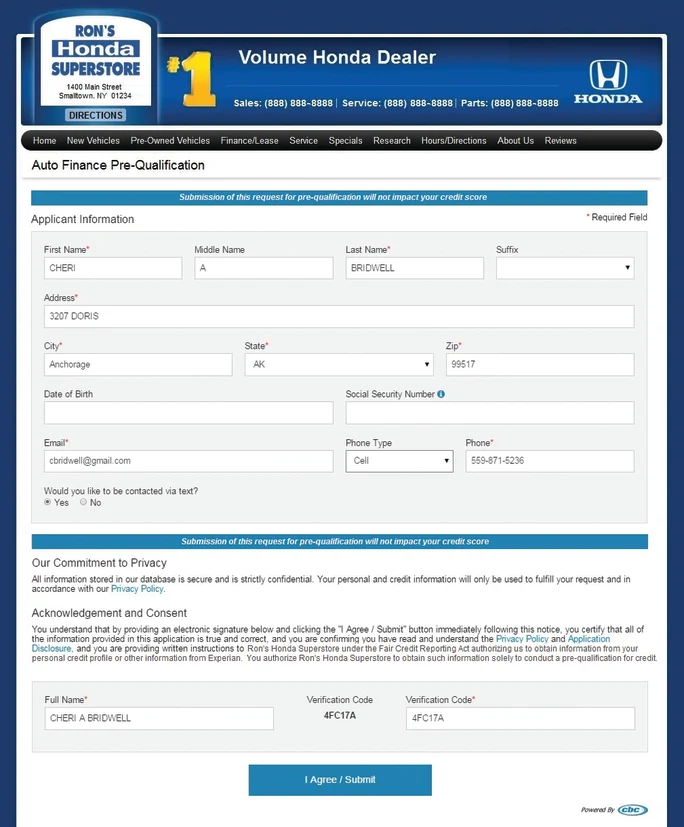
Prequalification is a fairly new form of soft pull. One of the key differences between a prequalification and a prescreen, which has been around for much longer, is that a prequalfication provides an acutal FICO score. Along with no negative effects on credit, a prequalification is also generally consented to by a customer. In the event that a customer qualifies for a loan after a prequalification, no firm offer of credit is required.
Larsen: It is, but the difference is that it’s not consumer consent-based. It’s generally done behind the scenes and initiated by the business without the consumer’s knowledge, much like they might get a prescreened credit card offer in the mail. They’ve done a prescreen on you, you’ve met the criteria, and then you receive the credit offer in the mail. There has to be a firm offer of credit, assuming you meet the prequalifications.
A lot of the prescreen soft pull products may not give an actual FICO score. Sometimes it’s a range — the FICO band within 20 to 30 points. Sometimes it’s just a “Yes, they met the criteria,” whatever that criteria was. So the data on the prescreen soft pull can sometimes be limited.
F&I: Let’s say a customer comes in for a test drive and the dealer asks for his or her driver’s license. If they pull the information from the customer’s driver’s license to see their credit score, would that be a prescreen?
Larsen: If the dealer gets the driver’s license, performs the soft pull and hands it back to the customer, then yes. And because no consent is required, that would be considered an instant prescreen, which is perfectly legal. But if the consumer meets the established criteria by the dealer and/or lenders, then the consumer does have to be provided with a firm offer of credit that spells out the details. So that’s the trade-off.
There’s also two flavors of prescreen: An instant prescreen like the scenario you described, which is probably more common in the dealership environment, and a batch prescreen. A batch prescreen is probably more commonly used to drive marketing campaigns or direct mail pieces. The same thing is happening behind the scenes: just one is happening in bulk and one is happening in real time.
F&I: From your perspective, why have “soft pulls” become such a hot topic?
Larsen: I think one of the reasons is consumers are more aware today. They’re more informed about credit, what impacts their credit score and how the credit process works. Many, many years ago, it was kind of a mystery to them, but now there’s a lot of information available to folks. People are monitoring their credit, maybe getting their FICO scores on their credit card statements or subscribing to a service. So a soft pull is an attractive process since it’s not going to impact the consumer’s FICO score and you’re not going to show several inquiries if they’ve been shopping for a particular car or mortgage.
F&I: What would happen if a dealer advertised or used a product without adhering to the set requirements?
Larsen: I think we all know that auto dealers are pretty large targets for aggressive lawyers or even class-action suits. So I guess there’s always that danger, and being ignorant to the different distinctions probably isn’t the best defense in that case.
There also is risk from the credit reporting agency side. If, via an audit or some sort of investigation by the credit reporting agencies, a dealership is found to be out of compliance or totally not abiding by the rules and ignoring any request to remediate or change, then they can be blacklisted from the credit reporting agencies and they will not be able to pull credit from one or more of those bureaus that blacklist them.
They also won’t be able to be issued credit in the future under that dealership name or address. Anybody associated with that subscriber code that was initially set up with the bureau gets put on a blacklist.
We have, unfortunately, seen some dealers land on that blacklist. All three of the bureaus have a blacklist that’s updated about monthly. As a reseller, we’re required to make sure they’re not on that blacklist before issuing subscriber codes.
More F&I

AI: Facilitator, Not Fixer, in F&I
The dealerships that thrive in the years ahead will be those that embrace technology while continuing to invest in the people who make customer interactions count.
Read More →
Modern Technology Objection Handling
In this video, Trent White shares how to confidently handle technology-based objections by helping customers understand the value of protection, even with modern vehicle technology.
Read More →
Consistency at Scale: Driving F&I Performance
With 75 rooftops across the Sunshine State, Morgan Auto Group has proven to Floridians that it knows a thing or two about driving performance in a competitive market. But it didn’t start at the top.
Read More →
Gitty Up on GAP
The foundational finance-and-insurance product hasn’t kept up with the latest conditions for auto dealers. Is the time ripe?
Read More →
How AI-Powered Coaching Is Transforming F&I Performance
See how AI-powered coaching can turn F&I customer conversations into actionable insights that support compliance, performance and profitability
Read More →
Sell Value, Build Trust
In this video, Trent White explains why selling on value, not fear, builds lasting customer trust, reduces cancellations, and drives long-term success.
Read More →
F&I Sales Give Dealers First-Half Lift
Product business shored up total profits to avoid an overall revenue tanking as product penetrations held steady, StoneEagle reported.
Read More →
Targeted Training Drives Results
Today’s technology, instead of threatening F&I managers, can actually make them better, according to an industry veteran who’s watched market setbacks roil the unprepared.
Read More →
Double the Change, Double the Chance
When an F&I manager gets a customer refusal, it’s a wise move to tweak more than one thing in the product offering.
Read More →
Just Do It
F&I managers need training, but instead of resisting application or expecting perfection, they should improve by simply acting on what they learn.
Read More →