



Smarter Choices Lead to Smarter Actions
When it comes to the buy-here, pay-here model, payment assurance technology definitely strengthens a dealer’s ability to keep customers current. But these devices are only part of the equation for a successful operation.
The costs associated with delinquencies and repossessions are well known to anyone trying to collect in the “C-” and below credit classes. However, if you don’t mind higher-than-necessary delinquencies and losing money, no need to read further.
The buy-here, pay-here (BHPH) and lease-here, pay-here (LHPH) models are all about collections, not vehicle sales. Over the years and through intense experience, one thing is for certain: We must understand the behaviors and habits of this customer segment in order to collect successfully. Anyone can sell, but collecting is an entirely separate issue.
Many dealers use lien holders or lessors, or use starter interrupts, locator systems or a combination of the two to strengthen their collections efforts. In some cases, these systems are used in place of good underwriting practices, which is not a recommended practice. These systems will perform well, but they are not magic bullets. If you agree, then keep on reading.
Understanding Payment Assurance Systems
Underwriting for ability and willingness is always recommended, just like selling vehicles that have a reasonable life expectancy and keeping payments in line with income. Payment assurance systems do work, but they shouldn’t take the place of good underwriting practices.
A recent trade publication indicated that fewer dealers utilized payment assurance systems in 2008 than in 2007. I find that impossible to accept. I currently sit on the board of the Payment Assurance Technology Association. Among our members, which include all of the major players in the segment, each one is experiencing increases in unit sales and in the number of active and new accounts.
But back to the issue at hand, payment assurance systems are vital tools when used properly. And these devices do empower dealers much like telephone and utilities companies are when it comes to delinquency. But the fact is the GPS-locator functions these devices tout are the least used feature. That’s because the location of the asset does not get the money in house, which is the primary goal when it comes to special finance.
Reducing Losses and Collections Staff
When it comes to special finance, it really does come down to behavior modification. Professionals in this arena say that if you don’t work to change your customer’s behavior, sometimes regularly, habits will not change.
That’s why two things need to happen in order to alter a special finance customer’s behavior. The first step is early detection and communication (reminding). The second step is intervention, which requires additional reminders, as well as consequences. Add these two steps together and you get prevention. And prevention equals profits for you.
In the collections arena, successful collections professionals practice this strategy everyday, because the results of preventing delinquencies and reducing charge-offs is worth the effort.
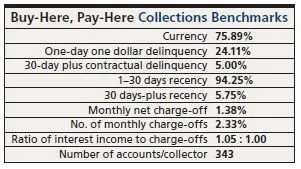
The folks doing benchmarks and static pools tell us that BHPH-level paper should be 72 to 75 percent current (see chart below). However, there are companies out there that are running over 90 percent current on “D” or below paper. Keeping customers current at levels like that means you can reduce collections staff by half or more.
[PAGEBREAK]
Early Warning Systems
So, if you are tired of the same old, same old, or your numbers are equal to the benchmark shown, read on. If not, thanks for your time and good selling. But if you are interested in further reducing losses and selling or financing more vehicles, then stay with me.
There are some pioneers and innovators in the payment assurance industry that have developed systems that not only help to modify behavior, but also increase the likelihood of collecting customer payments.
These proactive and preemptive communication systems employ automated text messages, e-mail, outgoing phone calls, and vehicle buzzers when situations escalate. Basically, these systems provide the early warnings to keep your customers current, and they do all the “heavy lifting” by handling all the communications when they’re not.
Users of these systems say they have increased their business by 20 percent. Some dealers even say these preemptive technologies have allowed them to go from 80 percent current to 92 to 97 percent current.
Payment assurance technology is definitely a key component to a special finance operation, but it’s only part of the equation. Remember, the key to special financing is making sure your customers are current on their payments, which is why a successful operation requires good underwriting practices and a preemptive communications system.
Ashley Herndon is a founding partner of the Irvine, Calif.-based payment assurance technology provider Crossbow Group Inc. E-mail him at aherndon@special-finance.com.
More F&I

AI: Facilitator, Not Fixer, in F&I
The dealerships that thrive in the years ahead will be those that embrace technology while continuing to invest in the people who make customer interactions count.
Read More →
Modern Technology Objection Handling
In this video, Trent White shares how to confidently handle technology-based objections by helping customers understand the value of protection, even with modern vehicle technology.
Read More →
Consistency at Scale: Driving F&I Performance
With 75 rooftops across the Sunshine State, Morgan Auto Group has proven to Floridians that it knows a thing or two about driving performance in a competitive market. But it didn’t start at the top.
Read More →
Gitty Up on GAP
The foundational finance-and-insurance product hasn’t kept up with the latest conditions for auto dealers. Is the time ripe?
Read More →
How AI-Powered Coaching Is Transforming F&I Performance
See how AI-powered coaching can turn F&I customer conversations into actionable insights that support compliance, performance and profitability
Read More →
Sell Value, Build Trust
In this video, Trent White explains why selling on value, not fear, builds lasting customer trust, reduces cancellations, and drives long-term success.
Read More →
F&I Sales Give Dealers First-Half Lift
Product business shored up total profits to avoid an overall revenue tanking as product penetrations held steady, StoneEagle reported.
Read More →
Targeted Training Drives Results
Today’s technology, instead of threatening F&I managers, can actually make them better, according to an industry veteran who’s watched market setbacks roil the unprepared.
Read More →
Double the Change, Double the Chance
When an F&I manager gets a customer refusal, it’s a wise move to tweak more than one thing in the product offering.
Read More →
Just Do It
F&I managers need training, but instead of resisting application or expecting perfection, they should improve by simply acting on what they learn.
Read More →