



The Seven Deadly Sins of F&I
More than 90 percent of F&I lawsuits were caused by the same problems, which are repeated again and again in dealerships around the country. Let’s review the seven deadly sins of F&I, as identified by AFIP’s David Robertson.

The number of regulations placed on dealerships is constantly increasing. With the Truth in Lending Act and the addition of 10 Federal Trade Commission (FTC) regulations and five federal laws, dealers must stay current with changes to compliance requirements. Even if a dealership is hit with a federal charge, the fine may be reduced if the noncompliant act is not something that happens frequently, and if the dealer can show evidence of compliance programs in place.
The National Association of Attorney Generals recently reported more than 40,000 consumer lawsuits filed against dealerships in the last two years. Of those, more than 6,000 were filed against the F&I department. More than 90 percent of F&I lawsuits were caused by the same problems, which are repeated again and again in dealerships around the country.
Let’s review the seven deadly sins of F&I, as identified by AFIP’s David Robertson.
1. The Word “Best”
“Best” should never be used when discussing the finance charge (APR). Although the F&I practitioner views the word “best” as the “buy-rate” plus a couple of points, a reporter or plaintiff’s attorney understands the word to imply that the quoted rate is either the dealer’s “buy-rate” or the lowest rate known to man. A better way to address an inquiry on the rate is to say it is the rate that is available for the person if he or she wishes to finance at the location where buying his or her car.
[PAGEBREAK]
2. Forging Signatures
A customer’s signature may never be forged on any document, as it is a felony.
3. Overstating Income
Overstating a customer’s income on a credit application might help you get the deal financed, but it can eventually lead to repossession and charge-backs. This action is a felony, costing the dealer a lot of money and negative attention from the media. At Gunderson Chevrolet in El Monte, Calif., the F&I department’s inflation of customer income led to the dealer paying a $2.5 million charge-back.
4. Mousing Menus
Menus are being configured to hide the loaded payment, or altered after the fact to document acceptance of products the customer did not agree to buy. If a menu is used, a copy should be kept on file to avoid any future legal problems.
5. Packing Payments
The payment quoted to a customer during the purchase process must be limited to the agreed-to cash price of the vehicle — as well as any applicable taxes and fees — at a representative APR and term. The California Car Buyer’s Bill of Rights specifically addresses the practice of payment packing. If the payment quoted is an estimate before checking a customer’s credit, it must be clearly stated that it is an estimate. In such instances, it is recommended that the APR be based on the average retail rate charged for that class of buyer (new or used, prime or nonprime) over the past 90 days. This gives the dealer a good basis for the quoted rate. The term should also reflect the repayment conditions for most deals.
6. Noncompliant Disclosure
The customer must be given ample time to review the contents of a contract before being asked to sign it. You cannot recite the disclosures for the customer. The new mantra for Reg. Z is the customer must hold, for the purpose of reviewing, the contract before signing. A customer must also be allowed to take a contract home to review prior to signing.
7. Flying Blind
This refers to executing contracts without knowing what they contain. In a 30-day period, an F&I practitioner will execute more contracts than a lawyer. The F&I practitioner must be knowledgeable in all of the terms and conditions found in the documents he or she is asking the customer to sign.
More F&I

Plug Your Profit Leaks
By building in clear processes, your dealership can realize more profits in plugged leaks to maximize sales opportunities.
Managing Expectations
Learn how proactive communication, setting clear expectations, and providing solutions when plans change can strengthen customer trust and improve the overall service experience.

The F&I Manager's Report Card
The best managers take the time and attention to measure the behaviors behind the numbers.

AI: Facilitator, Not Fixer, in F&I
The dealerships that thrive in the years ahead will be those that embrace technology while continuing to invest in the people who make customer interactions count.

Modern Technology Objection Handling
In this video, Trent White shares how to confidently handle technology-based objections by helping customers understand the value of protection, even with modern vehicle technology.

Consistency at Scale: Driving F&I Performance
With 75 rooftops across the Sunshine State, Morgan Auto Group has proven to Floridians that it knows a thing or two about driving performance in a competitive market. But it didn’t start at the top.

Gitty Up on GAP
The foundational finance-and-insurance product hasn’t kept up with the latest conditions for auto dealers. Is the time ripe?

How AI-Powered Coaching Is Transforming F&I Performance
See how AI-powered coaching can turn F&I customer conversations into actionable insights that support compliance, performance and profitability

Sell Value, Build Trust
In this video, Trent White explains why selling on value, not fear, builds lasting customer trust, reduces cancellations, and drives long-term success.
F&I Sales Give Dealers First-Half Lift
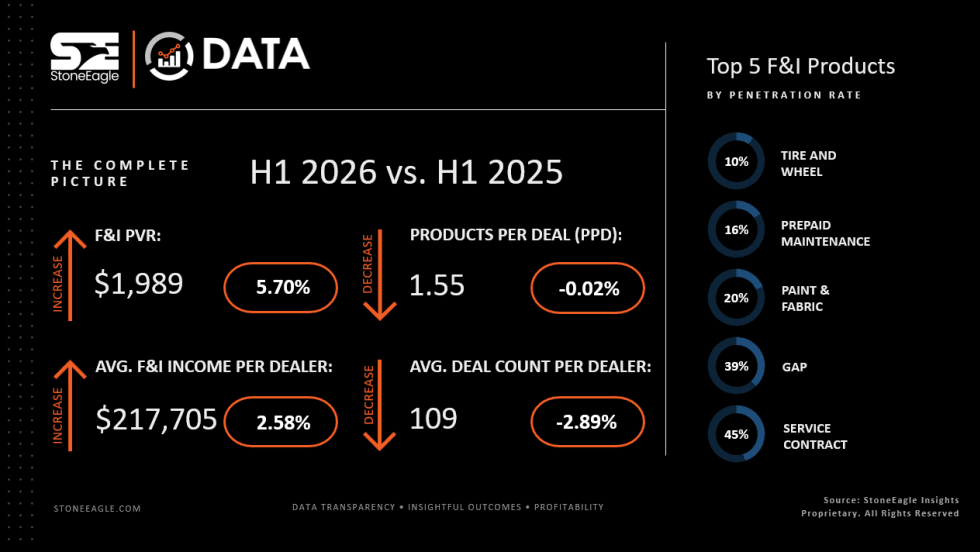
Product business shored up total profits to avoid an overall revenue tanking as product penetrations held steady, StoneEagle reported.