



Time to Move On
Unsure of where this recession is headed, I can’t blame lawmakers for their involvement, but can we make sure that all sides are heard before we jump to conclusions.

Unsure of where this recession is headed, I can’t blame lawmakers for their involvement, but can we make sure that all sides are heard before we jump to conclusions.
Take these consumer-protection bills Michael Benoit’s been writing about lately. While well intentioned, these bills could render F&I extinct while making it virtually impossible for downtrodden consumers to repair their credit.
Listen, I think we can all agree that there’s plenty of blame to spread around these days. Should we have counseled consumers on what finance-appropriate means? Sure. But shouldn’t consumers be educated enough to know how to use their credit. I just don’t buy the argument that creditors duped consumers into those exotic loans. I knew they were wrong for me when I applied for my home loan.
My point is government needs to take a step back and make sure its decisions aren’t made in a vacuum, or that lawmakers aren’t using this situation to grandstand in front of their constituents. Take this June 2 hearing proposed by the Senate Commerce Committee, which wants the CEOs of Chrysler and General Motors to explain the impacts of their recent actions. What is there to gain by doing that?
Shoot, Chrysler’s dealer cuts were made under the guise of bankruptcy, so what exactly does it have to explain? And if the question is how Chrysler intends to honor warranties, or redistribute parts and the 44,000 vehicles on the lots of those 789 cut dealers, I’ll send you my notes from Chrysler’s May 14 conference call. Heck, even the Chrysler Dealer Council isn’t balking at the automaker’s moves.
As for GM, there’s little doubt it’s headed for bankruptcy
after its failed attempt at a debt-for-equity swap with bondholders in May. And
the company’s been more than clear about not renewing the franchise agreements
of 1,124 “underperforming” dealerships come October 2010. And it was clear the
phasing out or sale of Saturn, Hummer, Saab and
Pontiac would result in another 505 dealer
cuts.
I agree with the argument that dealers are of no expense to these troubled automakers, but the fact is these companies have been trying to shed dealers for years. Chrysler attempted to do so with its Project Alpha in 2004, and is trying to do so again with its newest revival strategy, dubbed Project Genesis. Unfortunately, neither program has resulted in major cuts, which is why Chrysler chiefs Jim Press and Steve Landry heralded the chance do so under bankruptcy as a “once in a lifetime opportunity.”
“None of us want to eliminate dealers. These are longtime partners of the company,” they said. Bottom line, there just isn’t enough industry right now, which is why Chrysler is sacrificing 14 percent of its volume so the remaining 86 percent flourish.
But don’t get me wrong, it bothered me when the Chrysler execs said profitability and capital weren’t deciding factors in which dealers would remain, especially after learning that one of the dealers on Chrysler’s 40-page hit list employed one of my key contacts. Her name is Julie Horns, one of the most respected F&I managers on our Website’s forum.
Her Continental Chrysler Jeep store, which was set to celebrate its 55th anniversary on May 28, lost out to a Dodge dealership that opened up across the street last year. “How we didn’t meet the facility requirement is beyond me,” Horns said. “I have been taking calls from customers who are beside themselves about the possibility of not being able to service their vehicles here. It’s very sad. We love our customers here at Continental and that love for us was clearly shown by all the calls and e-mails we received.”
Initially, Horns said her dealership would fight Chrysler’s decision. That changed four days later, as she informed me that the dealership was working with the city of Countryside, Ill., to amend an ordinance that prohibited independent used-car dealerships from operating there.
“… With four Continental stores in town, all well run, all with clean updated state of the art facilities, and having lost three dealers in the past year and all their associated tax revenues, they may be willing to make an exception,” she wrote in an e-mail.
Yes, it’s difficult to swallow Chrysler’s and GM’s cuts, but what exactly will another hearing accomplish. It’s time to move on. Horns has, and so has the soon-to-be “Continental Used Car Superstore … Home of New-Car Satisfaction at a Used-Car Price.” And Lord knows there are plenty of used cars to sell.
More F&I

AI: Facilitator, Not Fixer, in F&I
The dealerships that thrive in the years ahead will be those that embrace technology while continuing to invest in the people who make customer interactions count.
Read More →
Modern Technology Objection Handling
In this video, Trent White shares how to confidently handle technology-based objections by helping customers understand the value of protection, even with modern vehicle technology.
Read More →
Consistency at Scale: Driving F&I Performance
With 75 rooftops across the Sunshine State, Morgan Auto Group has proven to Floridians that it knows a thing or two about driving performance in a competitive market. But it didn’t start at the top.
Read More →
Gitty Up on GAP
The foundational finance-and-insurance product hasn’t kept up with the latest conditions for auto dealers. Is the time ripe?
Read More →
How AI-Powered Coaching Is Transforming F&I Performance
See how AI-powered coaching can turn F&I customer conversations into actionable insights that support compliance, performance and profitability
Read More →
Sell Value, Build Trust
In this video, Trent White explains why selling on value, not fear, builds lasting customer trust, reduces cancellations, and drives long-term success.
Read More →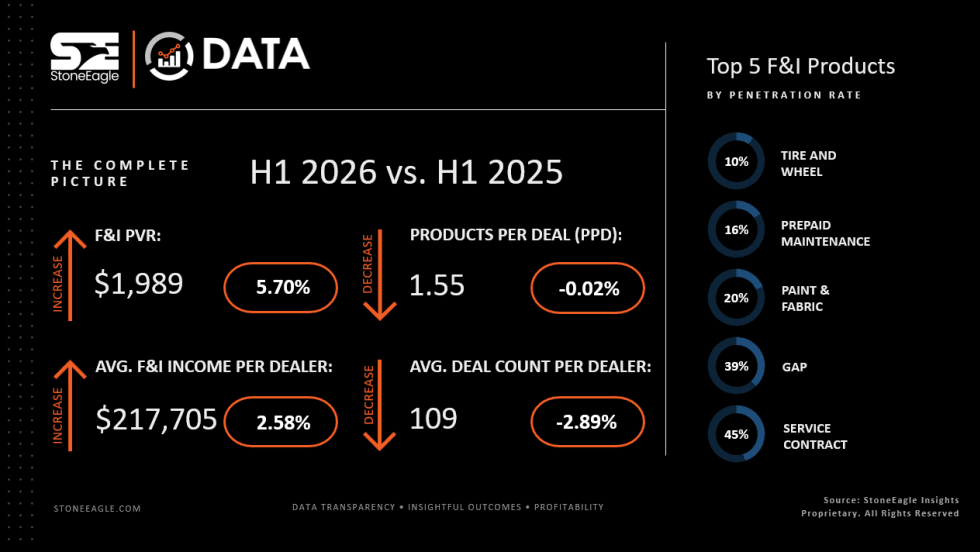
F&I Sales Give Dealers First-Half Lift
Product business shored up total profits to avoid an overall revenue tanking as product penetrations held steady, StoneEagle reported.
Read More →
Targeted Training Drives Results
Today’s technology, instead of threatening F&I managers, can actually make them better, according to an industry veteran who’s watched market setbacks roil the unprepared.
Read More →
Double the Change, Double the Chance
When an F&I manager gets a customer refusal, it’s a wise move to tweak more than one thing in the product offering.
Read More →
Just Do It
F&I managers need training, but instead of resisting application or expecting perfection, they should improve by simply acting on what they learn.
Read More →