



Westward Expansion
As the industry recovers, California continues to serve as the bellwether state for car sales nationwide.
The auto industry stands poised to sustain its recovery in 2013, with California leading the campaign to emerge from hard-hitting economic and natural disasters that have challenged auto dealers nationwide.
The favorable outlook this year can be attributed largely to the availability of low interest rates for new-car buyers, a revived real estate market and the need for consumers to replace aging vehicles.
“Most people are watching what’s happening in California,” says Brian Maas, director of government affairs for the California New Car Dealers Association (CNCDA), based in Sacramento. “California is the largest car market in the country; one out of every eight vehicles sold is in California. The largest number of new-car dealers is here. It’s a very robust market.”
Tim Dunne, director of global automotive analysis for J.D. Power and Associates, also believes California will continue to set the pace. “It is 12 percent of the population and one of the wealthiest states,” Dunne notes. “So what happens in California definitely has some impact on what happens in the [rest of the] country.”
The Golden State already has been shining fairly bright in terms of auto sales and financing.
A November report from J.D. Power and Associates noted that, in 2010, the state accounted for 10 percent of all national retail sales. By late 2012, California dealers caught up to their population, making up 12 percent of national retail sales.
Driven by Credit
In another indication of California’s clout, sales showed a 23 percent year-over-year increase, compared to 13 percent for the entire United States, according to the same J.D. Power study.

Paul Taylor, the NADA’s chief economist, says improving home prices should help sales in 2013.
Credit markets in 2012 also loosened well beyond the norm in California, with 44 percent more retail sales to car buyers holding the lowest D-level credit score of 624 or less compared to 2011, according to the report. In comparison, the national average increased 29 percent. California also had a double-digit lead in retail sales growth among all FICO scores compared to the rest of the country.
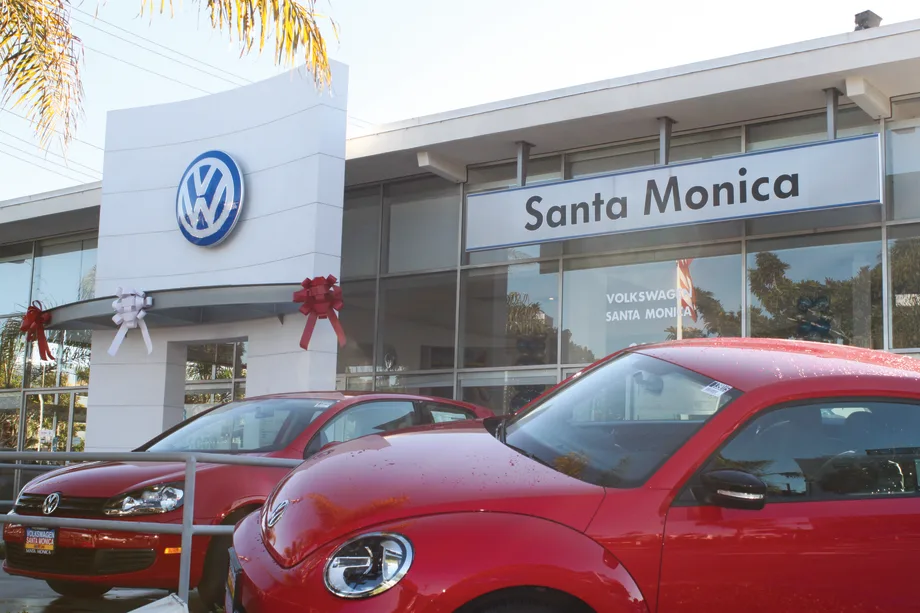
The low interest rates have been a big help at Volkswagen Santa Monica, the top-volume Volkswagen dealer in California, says Billy Rinker, general sales manager at the beachside dealership. It has been in operation since 1974 under the LAcarGUY family.
“When it’s at zero percent, 1.9 percent and 2.9 percent, those programs create public awareness and the perception that it’s a good time to buy a car,” Rinker says. “And that always helps.”
Rinker says he worked at the auto group’s Toyota Santa Monica dealership during the brunt of the worst economic downturn since the Great Depression. “We were one of the only groups to show a year-over-year sales increase during 2009, when everyone else was doing rough business due to the recession and other factors,” Rinker recalls.
The Volkswagen dealership now typically sells about 225 new cars per month and about 80 used. Rinker attributes the dealership’s success to his team’s ability to focus on generating sales rather than worrying about the economic situation. And by that he means his employees increased their customer outreach efforts.
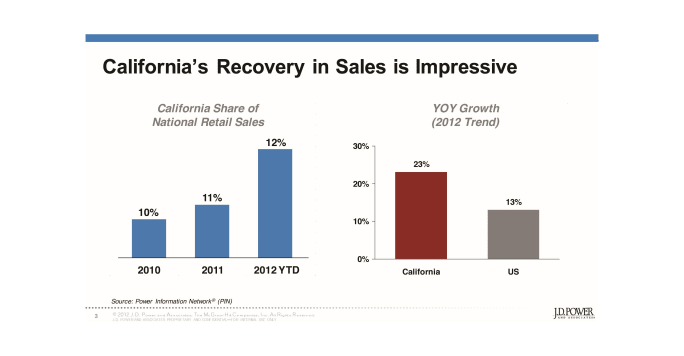
The graphs illustrate California’s importance to industry sales. Last year, the state’s share of national retail sales equaled its share of the U.S. population at 12 percent. California also led the rest of the country in sales growth last year.
Paul Taylor, chief economist with the National Automobile Dealers Association (NADA), says the historically low interest rates have had the added benefit of aiding floorplan-financing costs. “We’re looking at some interest rates we haven’t seen since Harry Truman was our president,” Taylor explains.
In December, dealers reported an average of $72 in floorplan assistance coming in for every new vehicle, Taylor notes, compared to several hundred dollars during strong growth periods.
Credit accessibility was still fairly tight 12 to 18 months ago, but slackened considerably in 2012, J.D. Power’s Dunne says. He also points to recent reports of a rebounding real estate market as a positive sign for the auto industry and the economy as a whole.
“Housing is the backbone of the U.S. economy, and it’s been looking better since the spring of 2012,” Dunne says.
All Eyes on Housing
The NADA’s Taylor also has been monitoring the real estate market state-by-state since the recession took hold in late 2007. His annual forecasts always include a note about the strong link between car sales and the performance of home prices. And in the third quarter, prices in California increased 7.2 percent from a year ago for homes under $1 million, he shares.
“Home equity is the nest egg of the typical middle-class household,” Taylor explains. “It’s very important for the state of California that housing prices are on the way back up.”
[PAGEBREAK]
Low interest rates last year helped Volkswagen Santa Monica pull skittish consumers off the sidelines.
California was one of six Western states to experience increases in home prices, ranging from a 6.6 year-over-year uptick in Arizona to a 20.06 percent rise in prices in Arizona — a nationwide high, according to the Federal Housing Finance Agency (FHFA). The Northeast, however, showed lackluster numbers: Maine recorded a year-to-year decrease of 2.6 percent in home prices and New York posted a 0.4 percent drop. Florida was the main bright spot on the East Coast, realizing a 7.9 percent increase in home prices. Delaware reported a 6 percent improvement.
“This is an important turnaround for residential real estate prices because the evaporation of home equity has stopped and it’s starting to recover,” Taylor says.
Time to Replace
The record age of vehicles on the road today also should continue to fuel demand. According to Polk, an automotive research firm headquartered in Southfield, Mich., the average age of the current fleet reached 11.1 years in 2012, up from 10.8 years the year before and 10.6 years in 2010.
The CNCDA’s Maas says the situation is what drove sales in California last year. “Because of the recession, folks were holding onto their cars longer and doing their best to keep them repaired, as opposed to making a new purchase.”
Unemployment will also be important to consumer confidence. The more the jobless rate falls, the more buyers will creep back into the market. And Maas says consumers who come off the sidelines will be treated to modern amenities and safety equipment missing from their aging vehicles.
“The additional features you can get in a vehicle [now] for relatively the same price [as] five to 10 years ago is truly remarkable,” Maas says. “There are very few manufactured products that can state that.”
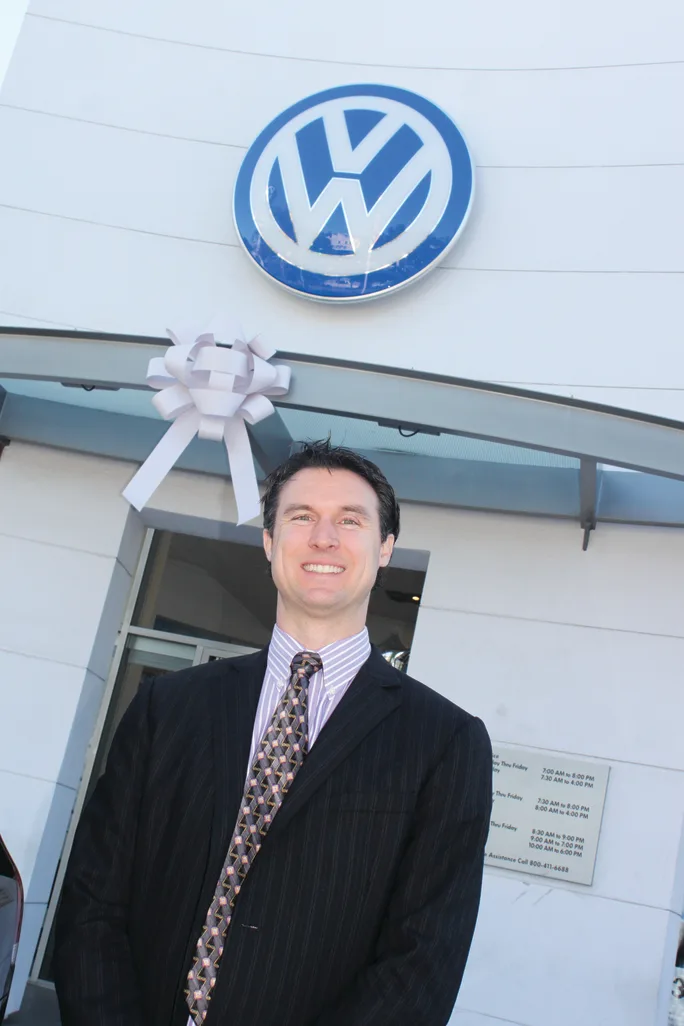
Billy Rinker attributes his dealership’s success last year to his team’s customer outreach efforts.
For roughly the same investment, the newer models are lighter, have better gas mileage and are loaded with the latest technology, Maas notes. “Multiple air bags, lane-sensing technology, sensors in front and rear, rear cameras; that tech was only found on the most expensive vehicles a decade ago,” Maas says. “But a large portion of the marketplace now has some version available.”
For those looking to California for other lessons, J.D. Power’s Dunne points out that, for the first time in five years, reliability was supplanted by fuel economy as the most important reason for making a purchase. Sixteen percent of new-car buyers in California listed “gas mileage” as the most influential purchase reason, followed by “reliability” at 13 percent and “performance” at 10 percent. Exterior styling, quality of workmanship and liking the image the vehicle portrays followed, all accounting for 8 percent.
The figures explain why compact cars accounted for 52 percent of retail sales in California last year, a figure that has steadily increased since 2007, when small cars made up 40 percent of vehicle sales.
“That’s likely driven by the fluctuation of gas prices throughout the year,” Dunne says. “People are just becoming more conscious of it and the effect it has on discretionary spending.”
The analysts agree that fuel prices are aiding the shift to smaller vehicles with better gas mileage, a point validated by J.D. Power’s finding that California was projected to make up 41 percent of all electric-vehicle sales in 2012.
Bumps in the Road
The positive outlook for 2013 could be derailed by a number of factors, Dunne says. He cautions that any flare-up of geopolitical tensions in the Middle East could impact gas supplies, and the European debt crisis remains unresolved. The pace of employment and an economic slowdown in China also could have serious consequences for dealers.
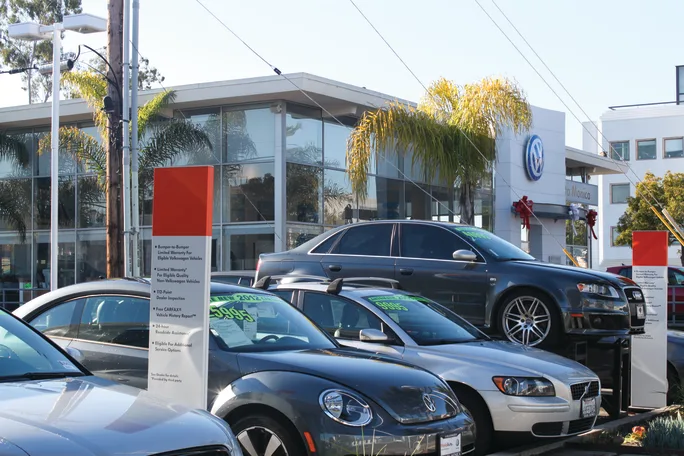
Volkswagen Santa Monica (Calif.) retails 225 new cars per month and 80 used. The beachside dealership has been in operation since 1974.
But natural disasters like the 2011 earthquake and tsunami that struck Japan and two major spikes in gas prices last year showed that consumers seem more desensitized to market volatility. In a recent statement, Jeff Schuster, senior vice president of forecasting at LMC Automotive, said that has everything to do with the need to replace aging vehicles.
“The irrepressible need and willingness of consumers to replace aging vehicles is stronger than the effects of natural disasters and fiscal turmoil both here and abroad,” Schuster wrote. “A sustained recovery pace in auto sales is expected over the next six months, but the medium-term forecast is still dependent on more pronounced economic activity and growth.”
Assuming a normal marketplace, however, the conditions look ripe for dealerships to continue to rebound. On a busy pre-Christmas day at the Volkswagen Santa Monica dealership, Rinker agrees: “We anticipate it will be a growth year.”
Paul Chavez is a freelance writer based in Venice, Calif. He can be reached at paul.chavez@bobit.com.
More F&I

AI: Facilitator, Not Fixer, in F&I
The dealerships that thrive in the years ahead will be those that embrace technology while continuing to invest in the people who make customer interactions count.
Read More →
Modern Technology Objection Handling
In this video, Trent White shares how to confidently handle technology-based objections by helping customers understand the value of protection, even with modern vehicle technology.
Read More →
Consistency at Scale: Driving F&I Performance
With 75 rooftops across the Sunshine State, Morgan Auto Group has proven to Floridians that it knows a thing or two about driving performance in a competitive market. But it didn’t start at the top.
Read More →
Gitty Up on GAP
The foundational finance-and-insurance product hasn’t kept up with the latest conditions for auto dealers. Is the time ripe?
Read More →
How AI-Powered Coaching Is Transforming F&I Performance
See how AI-powered coaching can turn F&I customer conversations into actionable insights that support compliance, performance and profitability
Read More →
Sell Value, Build Trust
In this video, Trent White explains why selling on value, not fear, builds lasting customer trust, reduces cancellations, and drives long-term success.
Read More →
F&I Sales Give Dealers First-Half Lift
Product business shored up total profits to avoid an overall revenue tanking as product penetrations held steady, StoneEagle reported.
Read More →
Targeted Training Drives Results
Today’s technology, instead of threatening F&I managers, can actually make them better, according to an industry veteran who’s watched market setbacks roil the unprepared.
Read More →
Double the Change, Double the Chance
When an F&I manager gets a customer refusal, it’s a wise move to tweak more than one thing in the product offering.
Read More →
Just Do It
F&I managers need training, but instead of resisting application or expecting perfection, they should improve by simply acting on what they learn.
Read More →