



AAA: Road De-Icers Cause $3 Billion Annually in Vehicle Rust Damage
The methods used to de-ice roadways cost 22 million American vehicle owners an estimated $15.4 billion in rust repairs over the last five years, according to a new AAA survey. The average cost to repair rust-related issues is $500.
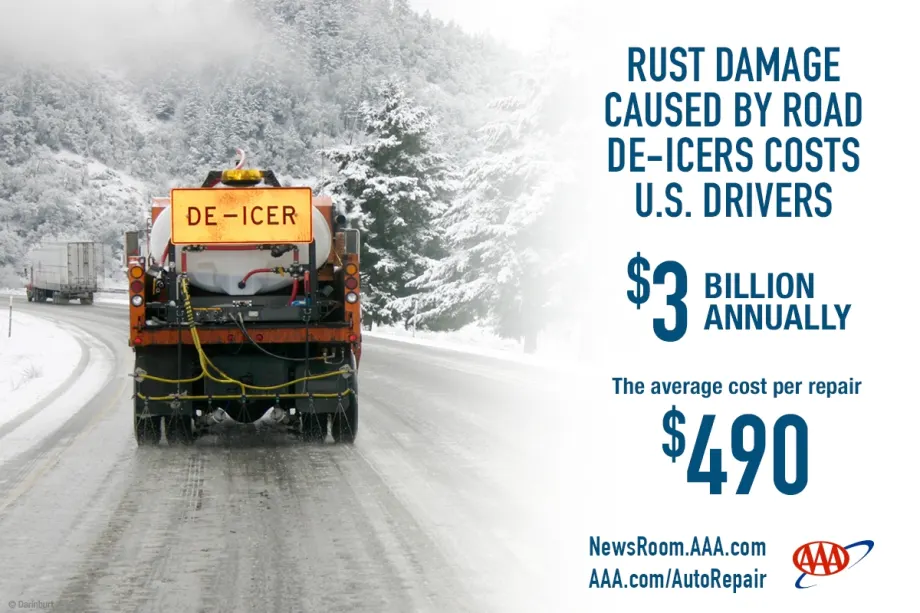
ORLANDO, Fla. — The methods used to de-ice roadways cost 22 million American vehicle owners an estimated $15.4 billion in rust repairs over the last five years, according to results from a new AAA survey. The average cost to repair rust-related issues is $500.
In recent years, many states and local transportation departments have shifted from using rock salt to liquid de-icers to combat ice and snow on roadways. These alternatives are more effective because they can be applied before a snowstorm and because they have a lower freezing point. However, these same characteristics can be even more damaging because the chemicals remain in liquid form longer and are more likely to coat components and seep into cracks where corrosion can accelerate.
“While the application of de-icing salts and solutions is critical to keeping our nation’s roadways safe every winter, it’s important that drivers pay attention to warning signs that they vehicle may be suffering from rust-related damage,” said John Nielsen, AAA’s managing director of Automotive Engineering and Repair. “This can be much more than a cosmetic issue, it can also create serious safety issues for drivers by impacting brake lines, exhaust systems, fuel tanks and electrical connection.
Pothole damage becomes another concern when the snow and ice melt. That’s when roadways begin to crumble. According to AAA, nearly 30 million U.S. drivers experienced pothole damage significant enough to require repair 2016, with repair bills ranging from less than $250 to more than $1,000.
More F&I

AI: Facilitator, Not Fixer, in F&I
The dealerships that thrive in the years ahead will be those that embrace technology while continuing to invest in the people who make customer interactions count.
Read More →
Modern Technology Objection Handling
In this video, Trent White shares how to confidently handle technology-based objections by helping customers understand the value of protection, even with modern vehicle technology.
Read More →
Consistency at Scale: Driving F&I Performance
With 75 rooftops across the Sunshine State, Morgan Auto Group has proven to Floridians that it knows a thing or two about driving performance in a competitive market. But it didn’t start at the top.
Read More →
Gitty Up on GAP
The foundational finance-and-insurance product hasn’t kept up with the latest conditions for auto dealers. Is the time ripe?
Read More →
How AI-Powered Coaching Is Transforming F&I Performance
See how AI-powered coaching can turn F&I customer conversations into actionable insights that support compliance, performance and profitability
Read More →
Sell Value, Build Trust
In this video, Trent White explains why selling on value, not fear, builds lasting customer trust, reduces cancellations, and drives long-term success.
Read More →
F&I Sales Give Dealers First-Half Lift
Product business shored up total profits to avoid an overall revenue tanking as product penetrations held steady, StoneEagle reported.
Read More →
Targeted Training Drives Results
Today’s technology, instead of threatening F&I managers, can actually make them better, according to an industry veteran who’s watched market setbacks roil the unprepared.
Read More →
Double the Change, Double the Chance
When an F&I manager gets a customer refusal, it’s a wise move to tweak more than one thing in the product offering.
Read More →
Just Do It
F&I managers need training, but instead of resisting application or expecting perfection, they should improve by simply acting on what they learn.
Read More →