



Detroit Brand Dealers Most Improved in 2010 Satisfaction Study
Mercedes-Benz dealerships ranked highest in the 2010 Pied Piper Prospect Satisfaction Index (PSI) U.S. Auto Industry Study, which used “mystery shoppers” to measure and compare how consumers are treated when shopping.
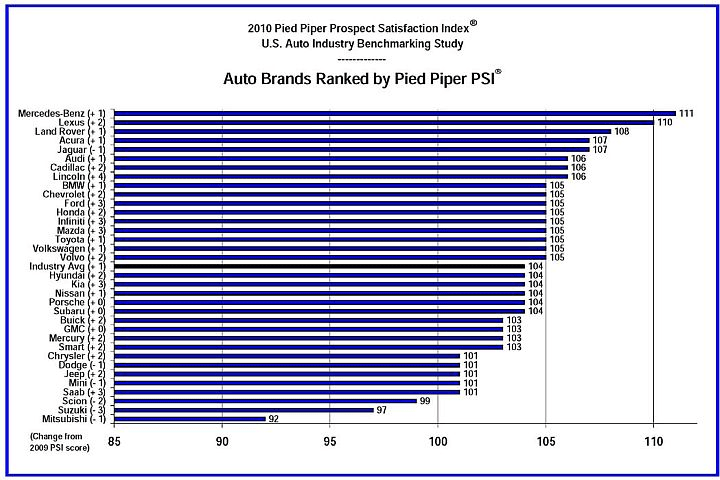
MONTEREY, Calif.– Mercedes-Benz dealerships ranked highest in the 2010 Pied Piper Prospect Satisfaction Index (PSI) U.S. Auto Industry Study, which used “mystery shoppers” to measure and compare how consumers are treated when shopping.
Detroit brands led the way in 2010 for most improvement, with Ford, Lincoln and Chevrolet scoring above the industry average for the first time since PSI auto industry benchmarking began four years ago.
The independent study sent 3,658 hired anonymous “mystery shoppers” into auto dealerships nationwide, then used the patent-pending PSI process to compile the results into an accurate measurement of how each brand’s dealerships treat car shoppers.
Overall auto industry performance improved notably from 2009 to 2010, with 25 of the 34 major auto brands achieving higher PSI scores. Although luxury brands continue to lead the industry for treatment of car shoppers, the improvement of mainstream brands has been striking. For example, when comparing the 2010 Ford shopping experience with that of 2007, the study found that the typical Ford salesperson was 52 percent more likely to discuss vehicle features unique from the competition, 29 percent more likely to introduce him or herself and 65 percent more likely to proactively mention the availability of different financing options.
Despite the widespread and continual improvement in how cars are sold, there is still plenty of room for improvement, although not necessarily in the expected areas. For example, the stereotypical car shopping experience of having an overbearing salesperson happened far less often (6 percent of the time) than the opposite: a salesperson who simply was not helpful enough and did not devote enough time and attention to the car shopper (18 percent of the time).
Another area of potential disappointment for car shoppers has been the decision by some brands and dealerships to limit or discontinue offering brochures. Industry wide, salespeople proactively offered a brochure following a visit only 57 percent of the time; the lowest level in the last three years.
Substantial variation in shopper treatment by brand continues. For example, both Volvo and BMW salespeople mentioned their brand’s maintenance program and associated costs 80 percent of the time or more, while shoppers looking for a Scion, Mitsubishi or Dodge heard about it less than one-third of the time.
Lexus and Porsche salespeople reviewed the vehicle’s features and controls 95 percent of the time before leaving on a test drive, but BMW salespeople reviewed it only 74 percent of the time.
At Land Rover, Smart or Mini dealerships, salespeople nearly always handled the entire visit themselves and rarely introduced shoppers to dealership management. In contrast, at Suzuki, Volkswagen, Nissan, Toyota and Infiniti dealerships the salespeople introduced shoppers to dealership management to help close the sale 40 percent of the time or more.
Salespeople who work for dealerships selling Nissan, Mazda, Infiniti, Mercedes-Benz, Toyota or Volkswagen were most likely to follow-up with shoppers within 48 hours after the initial visit, while salespeople who work for dealerships selling Buick, Mitsubishi, Chevrolet and Acura were least likely to follow-up with shoppers after the initial visit.
“Today’s car shoppers are armed with far more vehicle and pricing information than ever before,” said Fran O’Hagan, CEO of Pied Piper Management Co. LLC. “Successful brands and dealerships have responded by acting as helpful enablers for today’s shoppers. At the most successful dealerships, the stereotype of the old-fashioned car salesperson no longer exists.”
The 2010 Pied Piper PSI U.S. Auto Industry Study was conducted between July 2009 and June 2010 using 3,658 hired anonymous “mystery shoppers” at dealerships located throughout the U.S.
More F&I

Modern Technology Objection Handling
In this video, Trent White shares how to confidently handle technology-based objections by helping customers understand the value of protection, even with modern vehicle technology.
Read More →
Consistency at Scale: Driving F&I Performance
With 75 rooftops across the Sunshine State, Morgan Auto Group has proven to Floridians that it knows a thing or two about driving performance in a competitive market. But it didn’t start at the top.
Read More →
Gitty Up on GAP
The foundational finance-and-insurance product hasn’t kept up with the latest conditions for auto dealers. Is the time ripe?
Read More →
How AI-Powered Coaching Is Transforming F&I Performance
See how AI-powered coaching can turn F&I customer conversations into actionable insights that support compliance, performance and profitability
Read More →
Sell Value, Build Trust
In this video, Trent White explains why selling on value, not fear, builds lasting customer trust, reduces cancellations, and drives long-term success.
Read More →
F&I Sales Give Dealers First-Half Lift
Product business shored up total profits to avoid an overall revenue tanking as product penetrations held steady, StoneEagle reported.
Read More →
Targeted Training Drives Results
Today’s technology, instead of threatening F&I managers, can actually make them better, according to an industry veteran who’s watched market setbacks roil the unprepared.
Read More →
Double the Change, Double the Chance
When an F&I manager gets a customer refusal, it’s a wise move to tweak more than one thing in the product offering.
Read More →
Just Do It
F&I managers need training, but instead of resisting application or expecting perfection, they should improve by simply acting on what they learn.
Read More →
Dealer Lender Preferences Revealed
When lenders provide consistent, fast service, their overall satisfaction scores with dealers greatly improve, according to JD Power research.
Read More →