



F&I Still Revved Up in Q2
StoneEagle data show growth and products’ outsize role in profit protection.

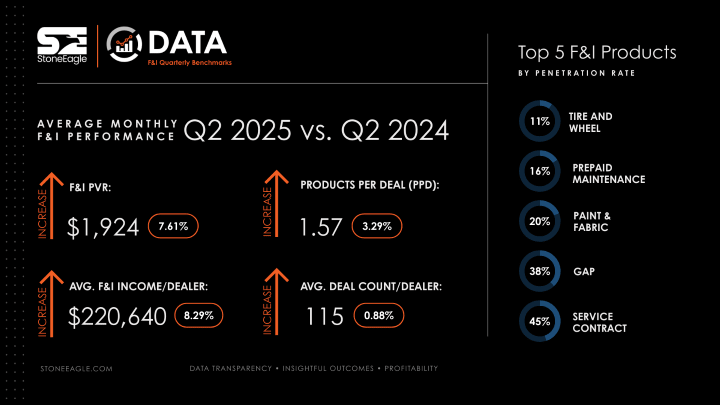
Most auto dealer F&I metrics rose in the second quarter, according to StoneEagle data.
StoneEagle
Finance-and-insurance product sales are helping shore up auto dealership revenues as consumer affordability and trade tariff challenges threaten front-end profits.
Though average front-end dealer gross profit in June totaled $695 per vehicle, down 26% since January and 40% from the 2024 peak, F&I results headed in the opposite direction, industry provider StoneEagle reported.
The front-end picture, though faded, was still up sharply from prepandemic levels, the company pointed out – by 72%.
Meanwhile, dealers’ average F&I profit per vehicle rose by about 5% quarter-over-quarter and 8% year-over-year to $1,924. Products per deal inched up from 1.54 in the first quarter to 1.57 – the average a year earlier was 1.52.
Average monthly F&I revenue also increased, up 8% both quarter-over-quarter and year-over-year to $220,640, StoneEagle calculated.
Consequently, gross profit per vehicle in June averaged $2,625, up 10% year-to-date and eclipsing prepandemic levels by 59%.
Though F&I revenue has receded somewhat from a robust March, when many consumers descended on dealers to beat anticipated vehicle price inflation resulting from U.S. trade tariffs, F&I remains a humming profit engine for dealers, StoneEagle said.
“It’s a testament to the resilience of F&I and its ability to steady the business when other parts of the dealership come under pressure,” said company CEO Cindy Allen.
Service contracts increased their share of F&I sales by a percentage point year-over-year to 45% penetration, according to the report, followed by the same jump for gap coverage to 38% and paint-and-fabric protection to 20%. Prepaid maintenance was flat at 16%, and tire-and-wheel plans rose a point to 11%.
LEARN MORE: In F&I, Innovation Is Overrated
More F&I

Modern Technology Objection Handling
In this video, Trent White shares how to confidently handle technology-based objections by helping customers understand the value of protection, even with modern vehicle technology.
Read More →
Consistency at Scale: Driving F&I Performance
With 75 rooftops across the Sunshine State, Morgan Auto Group has proven to Floridians that it knows a thing or two about driving performance in a competitive market. But it didn’t start at the top.
Read More →
Gitty Up on GAP
The foundational finance-and-insurance product hasn’t kept up with the latest conditions for auto dealers. Is the time ripe?
Read More →
How AI-Powered Coaching Is Transforming F&I Performance
See how AI-powered coaching can turn F&I customer conversations into actionable insights that support compliance, performance and profitability
Read More →
Sell Value, Build Trust
In this video, Trent White explains why selling on value, not fear, builds lasting customer trust, reduces cancellations, and drives long-term success.
Read More →
F&I Sales Give Dealers First-Half Lift
Product business shored up total profits to avoid an overall revenue tanking as product penetrations held steady, StoneEagle reported.
Read More →
Targeted Training Drives Results
Today’s technology, instead of threatening F&I managers, can actually make them better, according to an industry veteran who’s watched market setbacks roil the unprepared.
Read More →
Double the Change, Double the Chance
When an F&I manager gets a customer refusal, it’s a wise move to tweak more than one thing in the product offering.
Read More →
Just Do It
F&I managers need training, but instead of resisting application or expecting perfection, they should improve by simply acting on what they learn.
Read More →
Dealer Lender Preferences Revealed
When lenders provide consistent, fast service, their overall satisfaction scores with dealers greatly improve, according to JD Power research.
Read More →