



J.D. Power: Differing Approaches to Digital Financing Creates Wide Satisfaction Gap
While the digital application channel generated significantly higher levels of overall satisfaction in J.D. Power’s 2017 U.S. Consumer Financing Satisfaction Study, many consumers are waiting longer for a credit decision than those utilizing dealer representatives.
COSTA MESA, Calif. — Digital auto loan applications can lead to improved customer satisfaction, but wide variance in the execution of the digital application process has created a significant performance gap between top and bottom performing finance sources, according to the J.D. Power 2017 U.S. Consumer Financing Satisfaction Study.
The top-performing mass market and luxury finance sources rate significantly higher than the lowest performers (8.75 vs. 7.93 and 8.85 vs. 7.54, respectively, on a 10-point scale) in the most heavily weighted website attribute in the study: range of services that can be performed online.
“With such erratic approaches to digitalization, many auto lenders are failing to successfully capitalize on tremendous cost-cutting opportunities that have proven to boost customer satisfaction,” said Jim Houston, senior director of automotive finance at J.D. Power. “With some lenders varying widely on ease-of-use satisfaction scores for their digital offerings, a huge opportunity is going unmet by many.”
While the digital application channel generates significantly higher levels of overall satisfaction among both mass market and luxury customers, many are waiting longer for a credit decision than those utilizing dealer representatives. According to the study, just 30% of customers applying online received a credit decision within 15 minutes vs. 46% who filled out a paper application with a dealer.
The study also found that time given to make first payment provided the greatest impact on the onboarding experience. High-ranking mass market and luxury finance sources, for instance, performed highest on time given to make first payment, allowing an average lead time of 21.2 days for mass market customers and 18.4 days for luxury customers prior to first payment due date.
Driving the highest customer satisfaction were autopay and web-based payment services, with mass-market customers paying by hard-copy check significantly less satisfied than those using autopay (800 vs. 851, respectively, on a 1,000-point scale).
Lincoln Automotive Financial Services ranked highest among luxury brands with an 890 score, while Lexus Financial Services (875) ranked second and Acura Financial Services (855) ranked third.
Ford Credit ranked highest among mass market brands with a score of 857. BB&T/RAC (855) ranked second and Honda Financial Services (855) ranked third.
The 2017 U.S. Consumer Financing Satisfaction Study measures overall customer satisfaction in four factors: billing and payment process; onboarding process; phone contact; and website. Satisfaction is calculated on a 1,000-point scale. The study is based on responses from more than 14,500 customers who financed a new- or used-car loan or lease within the past four years and was fielded in July to August 2017.
More F&I

AI: Facilitator, Not Fixer, in F&I
The dealerships that thrive in the years ahead will be those that embrace technology while continuing to invest in the people who make customer interactions count.
Read More →
Modern Technology Objection Handling
In this video, Trent White shares how to confidently handle technology-based objections by helping customers understand the value of protection, even with modern vehicle technology.
Read More →
Consistency at Scale: Driving F&I Performance
With 75 rooftops across the Sunshine State, Morgan Auto Group has proven to Floridians that it knows a thing or two about driving performance in a competitive market. But it didn’t start at the top.
Read More →
Gitty Up on GAP
The foundational finance-and-insurance product hasn’t kept up with the latest conditions for auto dealers. Is the time ripe?
Read More →
How AI-Powered Coaching Is Transforming F&I Performance
See how AI-powered coaching can turn F&I customer conversations into actionable insights that support compliance, performance and profitability
Read More →
Sell Value, Build Trust
In this video, Trent White explains why selling on value, not fear, builds lasting customer trust, reduces cancellations, and drives long-term success.
Read More →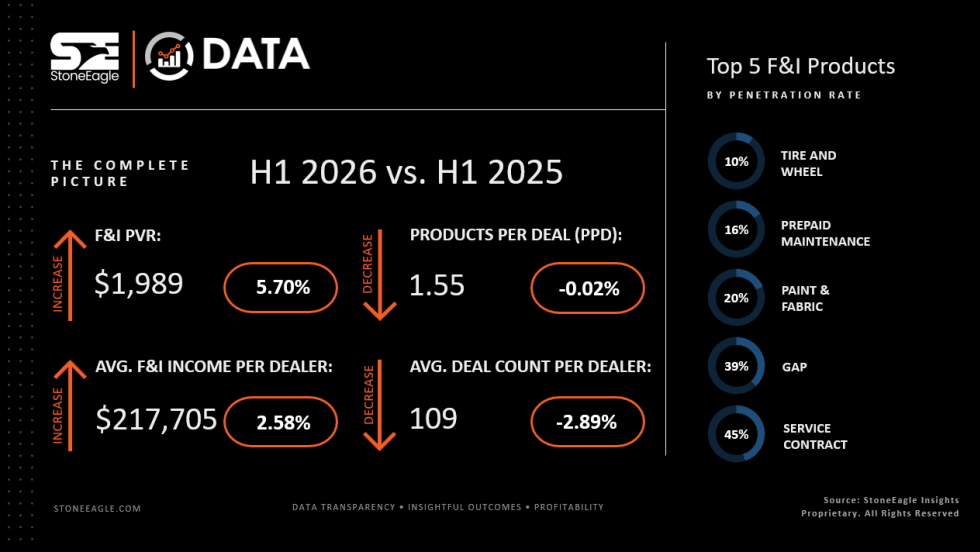
F&I Sales Give Dealers First-Half Lift
Product business shored up total profits to avoid an overall revenue tanking as product penetrations held steady, StoneEagle reported.
Read More →
Targeted Training Drives Results
Today’s technology, instead of threatening F&I managers, can actually make them better, according to an industry veteran who’s watched market setbacks roil the unprepared.
Read More →
Double the Change, Double the Chance
When an F&I manager gets a customer refusal, it’s a wise move to tweak more than one thing in the product offering.
Read More →
Just Do It
F&I managers need training, but instead of resisting application or expecting perfection, they should improve by simply acting on what they learn.
Read More →