



Subprime Borrowers, Expected Interest Rate Hikes to Drive Up Delinquency Rates in 2017
Transunion projects the auto loan delinquency rate for consumers with payments 60 or more days past due to close the year at 1.4%, the highest level since year-end 2009. Even with this increase, TransUnion said delinquency rates will remain well below levels observed during the last recession.
CHICAGO — Projected interest rate hikes and more subprime borrowers in the consumer lending market are expected to fuel a rise in delinquency rates in 2017 for auto loans and credit cards, according to TransUnion’s 2017 Consumer Credit Market Forecast.
The firm said it also expects serious mortgage loan delinquency rates to drop, while unsecured consumer loan delinquencies are expected to experience only a minimal increase next year.
“The consumer credit markets have been functioning extremely well the last few years, but an increase in subprime lending has begun to impact delinquency levels for some industries, specifically the auto financing and credit card markets. … For auto finance, this figure is now at its highest point since the conclusion of 2013,” said Nidhi Verma, senior director of research and consulting in TransUnion’s financial services business unit.
Transunion projects the auto loan delinquency rate for consumers with payments 60 or more days past due to close the year at 1.4%, the highest level since year-end 2009. Even with this increase, TransUnion said delinquency rates will remain well below levels observed during the last recession, when delinquency rates stood at 1.59% for consumers 60 days or more past due.
“Greater access to auto loans for nonprime consumers suggests that lenders have made deliberate decisions to accept more risk from nonprime loans in their portfolio,” said Jason Laky, senior vice president and automotive and consumer lending business leader for Transunion. He put the fourth quarter delinquency rate at 1.36%, a 7% increase from a year ago.
“An increase in delinquency is the natural consequence of that strategy," he added. "If lenders are compensated for the additional risk in the portfolio, a modest increase in delinquency should not disrupt the auto finance market. We do not expect to see a surge in auto delinquency unless there is an economic shock.”
In the third quarter of this year, there were 74.8 million auto loan accounts, according to TransUnion. Of those accounts, 25.1 million belonged to nonprime consumers, a 7.5% increase from a year ago.
Due to the expected tapering of annual growth rates for new-vehicle sales and today’s expected interest rate hike, TransUnion expects auto sales to still grow but at a lower rate than in recent years. Additionally, growth in the average auto balance per consumer is expected to slow to levels last observed in 2011, with the average balance expect to grow at a rate of 2.4% between year-ends 2015 and 2016. The growth rate between the fourth quarters of 2014 and 2015 was 3.1%, while the rate between the fourth quarters of 2013 and 2014 was 4%.
Additionally, average auto balances are expected to reach $18,435 in the fourth quarter of 2016, and $18,840 in the fourth quarter of 2017. "Average auto balance growth began to slow at the beginning of 2016, and we expect this more moderate growth to continue through 2017 if wage growth continues," Laky said.
More F&I

AI: Facilitator, Not Fixer, in F&I
The dealerships that thrive in the years ahead will be those that embrace technology while continuing to invest in the people who make customer interactions count.
Read More →
Modern Technology Objection Handling
In this video, Trent White shares how to confidently handle technology-based objections by helping customers understand the value of protection, even with modern vehicle technology.
Read More →
Consistency at Scale: Driving F&I Performance
With 75 rooftops across the Sunshine State, Morgan Auto Group has proven to Floridians that it knows a thing or two about driving performance in a competitive market. But it didn’t start at the top.
Read More →
Gitty Up on GAP
The foundational finance-and-insurance product hasn’t kept up with the latest conditions for auto dealers. Is the time ripe?
Read More →
How AI-Powered Coaching Is Transforming F&I Performance
See how AI-powered coaching can turn F&I customer conversations into actionable insights that support compliance, performance and profitability
Read More →
Sell Value, Build Trust
In this video, Trent White explains why selling on value, not fear, builds lasting customer trust, reduces cancellations, and drives long-term success.
Read More →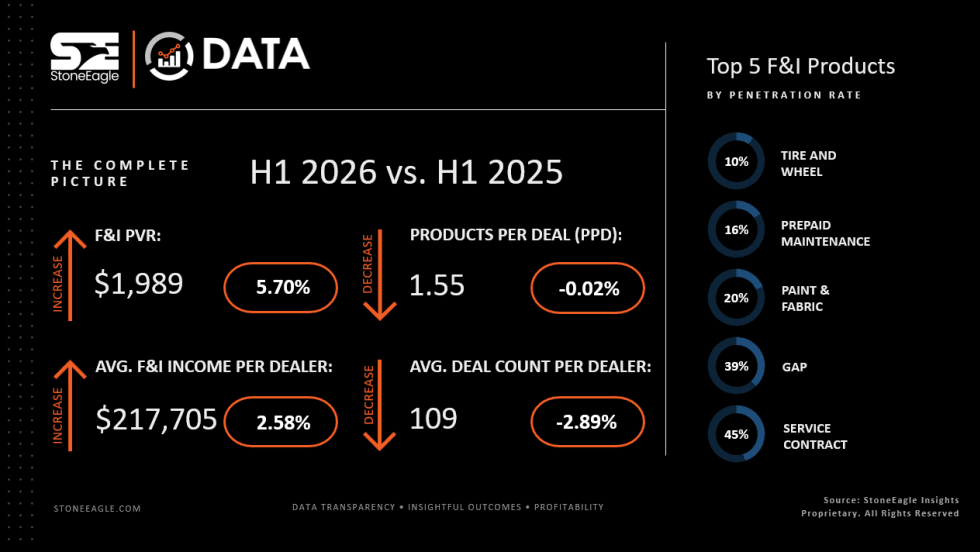
F&I Sales Give Dealers First-Half Lift
Product business shored up total profits to avoid an overall revenue tanking as product penetrations held steady, StoneEagle reported.
Read More →
Targeted Training Drives Results
Today’s technology, instead of threatening F&I managers, can actually make them better, according to an industry veteran who’s watched market setbacks roil the unprepared.
Read More →
Double the Change, Double the Chance
When an F&I manager gets a customer refusal, it’s a wise move to tweak more than one thing in the product offering.
Read More →
Just Do It
F&I managers need training, but instead of resisting application or expecting perfection, they should improve by simply acting on what they learn.
Read More →