



Total Auto Loans, Balances at 40-Month Highs, Equifax Reports
The credit reporting agency reported that balances on outstanding loans are at a 48-month high, while the total number of existing loans reach a 42-month high.
ATLANTA — According to Equifax’s latest National Consumer Credit Trends Report, balances on outstanding auto loans at the end of January totaled $782 billion, the highest level since January 2009. The report also showed that the total number of existing loans stands at 59 million, the highest level since July 2009, a 42-month high.
By source, loans funded through financial institutions are at more than $372 billion, a 60-month high. And at more than $409 billion, balances on loans funded by auto finance companies are at its highest level in 46 months.
Delinquency rates within the auto portfolio are also improving. By year-end 2012, they decreased by nearly 11 percent from same time a year ago, while auto loan and lease losses in that same period dropped nearly 10 percent.
“Sales of new cars and light trucks are rising steadily, though they are still well below prerecession levels of roughly 17 million units,” said Equifax Chief Economist Amy Crews Cutts. “Yet auto lending, including leases, is now back to pre-recession levels, driven in part by the very attractive interest rates being offered on these loans and a gradual increase in willingness to lend to less-than-perfect credit borrowers.”
Other highlights from the most recent data include:
• The most recent data shows that auto loans originated between January and November 2012 totaled $387.7 billion, a six-year high and representing nearly 46 percent of total consumer credit originated ($825 billion) for that same time.
• Total number of new auto loans originated between January-November 2012 was 19.9 million, a six-year high and an increase of more than 11 percent from January to November 2011.
• New auto loans funded in November 2012 by banks, savings and loans or credit unions increased nearly 13 percent over November 2011 totals (749,800 to 857,300).
• For January-November 2012, auto lending to subprime borrowers (origination risk scores less than 640) has increased more than 18 percent on a year-over-year basis to 6.1 million.
More F&I

AI: Facilitator, Not Fixer, in F&I
The dealerships that thrive in the years ahead will be those that embrace technology while continuing to invest in the people who make customer interactions count.
Read More →
Modern Technology Objection Handling
In this video, Trent White shares how to confidently handle technology-based objections by helping customers understand the value of protection, even with modern vehicle technology.
Read More →
Consistency at Scale: Driving F&I Performance
With 75 rooftops across the Sunshine State, Morgan Auto Group has proven to Floridians that it knows a thing or two about driving performance in a competitive market. But it didn’t start at the top.
Read More →
Gitty Up on GAP
The foundational finance-and-insurance product hasn’t kept up with the latest conditions for auto dealers. Is the time ripe?
Read More →
How AI-Powered Coaching Is Transforming F&I Performance
See how AI-powered coaching can turn F&I customer conversations into actionable insights that support compliance, performance and profitability
Read More →
Sell Value, Build Trust
In this video, Trent White explains why selling on value, not fear, builds lasting customer trust, reduces cancellations, and drives long-term success.
Read More →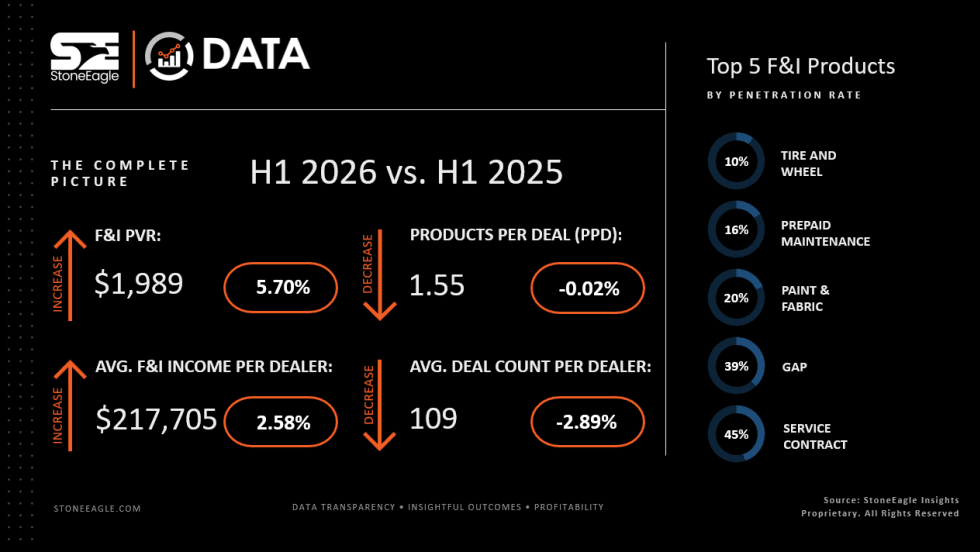
F&I Sales Give Dealers First-Half Lift
Product business shored up total profits to avoid an overall revenue tanking as product penetrations held steady, StoneEagle reported.
Read More →
Targeted Training Drives Results
Today’s technology, instead of threatening F&I managers, can actually make them better, according to an industry veteran who’s watched market setbacks roil the unprepared.
Read More →
Double the Change, Double the Chance
When an F&I manager gets a customer refusal, it’s a wise move to tweak more than one thing in the product offering.
Read More →
Just Do It
F&I managers need training, but instead of resisting application or expecting perfection, they should improve by simply acting on what they learn.
Read More →