



TransUnion: Auto Debt Rises Again, Deliquencies Remain Subdued
TransUnion reported this week that auto loan debt per borrow increased for the 11th straight quarter, while delinquencies remained below the fourth quarter average observed between 2007 and 2013.
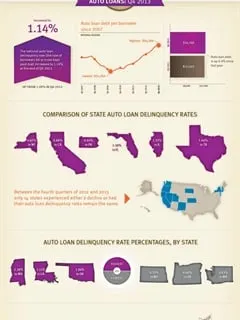
CHICAGO — In the fourth quarter, auto loan debt per borrower increased for the 11th straight quarter, rising 4.4% from the year-ago period to $16,769, according to TransUnion. On a quarterly basis, auto loan debt was up from $16,685 in third quarter 2013.
The firm also reported that the 60-day delinquency rate increased from 1.04% in the year-ago quarter and 1.09% in the third quarter 2013 to 1.14%. However, the rate remained below the fourth quarter average observed between 2007 and 2013.
"While we observed an uptick in auto loan delinquencies, there are reasons to believe they will continue to remain relatively low in the near future," said Pete Turek, vice president of automotive in TransUnion's financial services business unit. "First, while auto loan originations are increasing at a rapid pace, the percentage of nonprime accounts remains low. In fact, the percentage of nonprime borrowers for all auto loan accounts was lower in the [fourth quarter] than it was the previous year"
The subprime delinquency rate — consumers with a VantageScore of less than 641 on a scale of 501-990 — increased from 5.73% in the fourth quarter 2012 to 6.12%. "While this is nearly a 7% yearly increase, it should be noted that subprime delinquencies remain below levels we observed during the recession," Turek noted.
TransUnion recorded 60.5 million auto loan accounts as of the fourth quarter, up from 57 million in the year-ago quarter. Viewed one quarter in arrears (to ensure all accounts are included in the data), new account originations increased to 6.64 million in Q3 2013, up from 5.99 million in Q3 2012.
The share of nonprime —VantageScore 2.0 credit scores of less than 700 — grew by 16 basis points (from 32.37% in the third quarter 2012 to 32.53% in the third quarter 2013). This percentage is still much lower than what was observed prerecession (36.97% in the third quarter 2007).
"We expect share of nonprime, higher risk loan originations to continue trending upward due to the growth of competitors in this segment," Turek noted.
Delinquencies either declined or remained flat from a year ago in 14 states. The largest delinquency declines occurred in Oregon, New Jersey and Delaware, while the largest increases occurred in Michigan, Alaska and Arkansas. Auto loan balances rose in every state between the fourth quarter 2012 to the fourth quarter 2013.
TransUnion is forecasting delinquency rates to drop to 1.02% in the opening quarter of 2014 due to historic seasonality associated with auto financing. "Auto delinquencies tend to drop in the first quarter of the year, and we expect current market conditions will place downward pressure on delinquencies," said Turek.
More F&I

Modern Technology Objection Handling
In this video, Trent White shares how to confidently handle technology-based objections by helping customers understand the value of protection, even with modern vehicle technology.
Read More →
Consistency at Scale: Driving F&I Performance
With 75 rooftops across the Sunshine State, Morgan Auto Group has proven to Floridians that it knows a thing or two about driving performance in a competitive market. But it didn’t start at the top.
Read More →
Gitty Up on GAP
The foundational finance-and-insurance product hasn’t kept up with the latest conditions for auto dealers. Is the time ripe?
Read More →
How AI-Powered Coaching Is Transforming F&I Performance
See how AI-powered coaching can turn F&I customer conversations into actionable insights that support compliance, performance and profitability
Read More →
Sell Value, Build Trust
In this video, Trent White explains why selling on value, not fear, builds lasting customer trust, reduces cancellations, and drives long-term success.
Read More →
F&I Sales Give Dealers First-Half Lift
Product business shored up total profits to avoid an overall revenue tanking as product penetrations held steady, StoneEagle reported.
Read More →
Targeted Training Drives Results
Today’s technology, instead of threatening F&I managers, can actually make them better, according to an industry veteran who’s watched market setbacks roil the unprepared.
Read More →
Double the Change, Double the Chance
When an F&I manager gets a customer refusal, it’s a wise move to tweak more than one thing in the product offering.
Read More →
Just Do It
F&I managers need training, but instead of resisting application or expecting perfection, they should improve by simply acting on what they learn.
Read More →
Dealer Lender Preferences Revealed
When lenders provide consistent, fast service, their overall satisfaction scores with dealers greatly improve, according to JD Power research.
Read More →