



Trump, Democrats Agree to Revised USMCA
President Donald Trump, House Speaker Nancy Pelosi, and factory and labor officials all cheered the imminent passage of a revised version of the U.S.-Mexico-Canada trade bill.

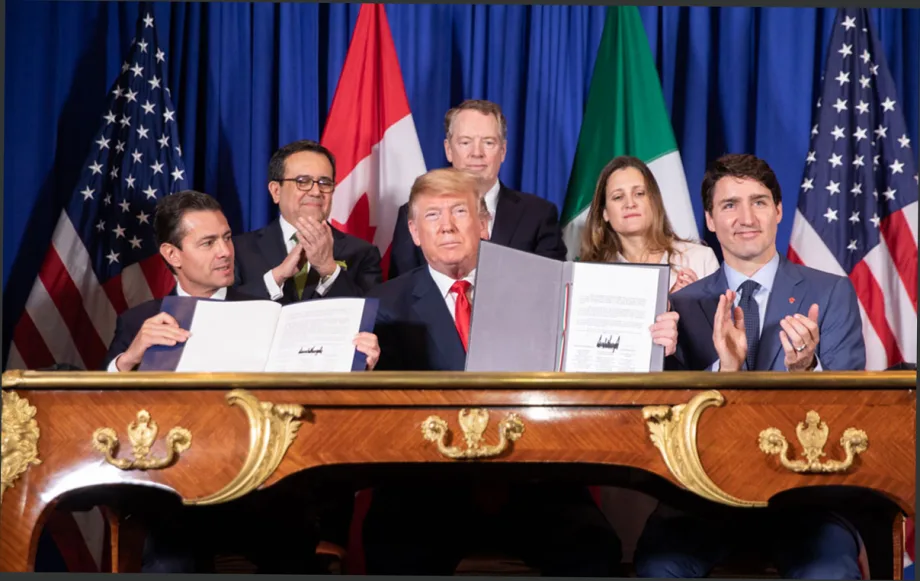
President Donald Trump is flanked by then-Mexican President Enrique Peña Nieto and Canadian Prime Minister Justin Trudeau in a signing ceremony for the preliminary tripartite trade agreement at the G20 Summit in Buenos Aires on Nov. 30, 2018. Mexico’s current president, Andrés Manuel López Obrador, took office the next day.
Photo courtesy The White House via Flickr
WASHINGTON — Republicans and Democrats have agreed to a revised version of the U.S.-Mexico-Canada trade agreement, all but assuring its passage after more than a year of negotiations. President Donald Trump, U.S. House Speaker Nancy Pelosi, automotive manufacturers, and union representatives all praised the bill, which replaces the North American Free Trade Agreement of 1994.
“America’s great USMCA Trade Bill is looking good. It will be the best and most important trade deal ever made by the USA,” Trump wrote in a tweet, adding that NAFTA was “our Country’s worst Trade Deal.”
The bill is expected to face a full House vote next week and rapid passage in the Senate before heading to Trump’s desk for a final signature.
Negotiations were led by U.S. Trade Representative Robert Lighthizer on the Republican side; his Democratic counterpart was House Ways and Means Chairman Rep. Richard Neal of Massachusetts. Democrats secured a series of revisions covering environmental, pharmaceutical, labor, and enforcement issues.
“This is the day we have been waiting for,” Pelosi said Tuesday. “It is infinitely better than what was initially proposed by the administration.”
“We demanded a trade deal that benefits workers and fought every single day to negotiate that deal.”
The deal was also endorsed in official statements from U.S. carmakers, which praised USMCA as “vital to the success of the North American auto industry” (General Motors) and “allows the U.S. auto industry to be globally competitive” (Ford).
“We demanded a trade deal that benefits workers and fought every single day to negotiate that deal; and now we have secured an agreement that working people can proudly support,” added Richard Trumka, president of the AFL-CIO, America’s biggest labor union. “Trade rules in America will now be fairer because of our hard work and perseverance. Working people have created a new standard for future trade negotiations.”
Originally posted on Auto Dealer Today
More Showroom

New Cars Less Affordable
Buying conditions eroded for American shoppers last month due to inflation and interest rates, though they fared better than a year ago.

October Sales Divided
Inventory trends split between the new- and used-vehicle markets, though prices continued to rise for both in October.
Auto Transaction Prices Hit New Height
October sales of big, pricey models push up the average, even as budget-conscious consumers snag more economical options.

Making the Safe Choice
Kelley Blue Book has turned households with teen drivers onto safe and affordable options for their vehicles of choice
Inventory Holds Steady
September new-vehicle inventory rose slightly month-over-month, but dealer lots are laden with MY2026 vehicles as the typical model year changeover trudges along.

October Auto Sales Fall With the Leaves
A forecast anticipates retail deliveries are down this month as consumers continue to face cost challenges, though more are tapping long loans in order to buy.
California Sees Quarterly Gains
California’s new-vehicle market saw a boost in hybrids in the third quarter and its first overall quarterly market gain of the year.
New-Vehicle Prices Stay Put
Affordability pressures and model availability shaped new-vehicle sales in September, according to an analysis by Kelley Blue Book.
EV Buyer Consideration Shifts
What drives American consumers to purchase an electric vehicle is shifting as the question moves away from Should I?' to 'Which features and experience do I want to have?'

Year-to-Date Auto Sales Holding Their Own
A forecast through August shows that automakers have shifted strategies to keep deliveries and revenues up despite tariffs and other economic challenges.