



California Dealers Prepare for New Law
Signed into law last year, the requirements of the California Car Buyer’s Bill of Rights go into effect July 1. Many changes center around the F&I office, including credit score disclosures and interest rate caps.
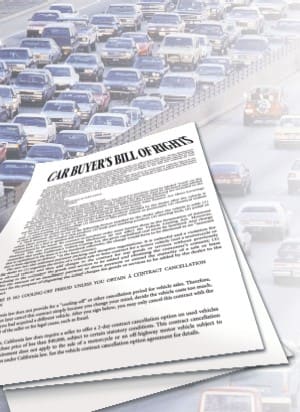
California’s AB 68, the Car Buyer’s Bill of Rights, is chock full of changes that will be mandatory beginning July 1. These changes primarily affect California licensed motor vehicle dealers and their buyers, and indirectly, those who purchase conditional sale contracts from such dealers.
Use of the Term ‘Certified’ Has Restrictions
The new provisions designate which used vehicles are not eligible for advertisement or sale as “certified” or other similar designation. For example:
Odometer on the vehicle does not indicate actual mileage
Vehicle was reacquired by the manufacturer or any dealer pursuant to state or federal warranty laws (buy-back)
Certificate of title has been branded “Lemon Law Buyback,” “manufacturer repurchase,” “salvage,” “junk,” “nonrepairable,” “flood” or a similar designation
Vehicle has sustained frame damage — or damage in an impact, fire or flood — that after repair substantially impairs the use or safety of the vehicle.
To be a certified vehicle, prior to sale, the dealer must provide the buyer with a completed inspection report indicating all the components inspected. A certified vehicle cannot be sold “as is.” Furthermore, a dealer engages in an unlawful activity if, in the advertising or use of the term “certified” or any similar descriptive term, the statement is found to be untrue or misleading.
These restrictions do not apply to motorcycles or off-road vehicles.
When Credit Score Must be Disclosed to Customer
The new law does not require dealers to tell consumers the lowest interest rate for which they qualify. Nor is there a requirement to disclose the buy rate or amount of finance reserve.
However, consumers must be informed of their credit score in certain situations. This affects dealers who obtain a consumer credit score from a credit reporting agency in connection with an application for credit. The application can be for the purchase or lease of a new or used vehicle, but not a motorcycle or an off-road vehicle. It requires dealers to provide on a separate notice printed in 10-point, boldface type: (1) the credit score obtained and used by the dealer and the name and address of the credit reporting agency providing the score; (2) the range of possible credit scores established by the credit reporting agency that provided the credit score; and (3) a printed “Notice to Credit Applicant” in the form specified.
The notice must be given “before the purchase or lease” of the vehicle. The dealer’s obligation only extends to one disclosure per purchase or lease transaction, and applies to a credit application that is approved, counter-offered or declined. It appears that if the dealer obtains more than one credit score from credit reporting agencies, the dealer need only disclose the one “used” and not all of them.
F&I Products Must be Separately Disclosed
Disclosures on the retail installment contract and purchase order are affected by this law. These disclosures apply to the purchase of new and used motor vehicles, but not motorcycles or off-road vehicles. For purchases (but not leases), a stand-alone disclosure is also required and appears to apply to new and used vehicles as well as motorcycles and off-road vehicles. (This seems to have been an oversight as the bill was making its way through the legislature and to the governor’s desk for signature.)
Before a buyer signs a retail installment contract for the purchase of a new or used motor vehicle (there is no reference here to excluding motorcycles or off-road vehicles), the dealer must provide a separate disclosure form printed in at least 10-point type for the buyer to sign. This form must include a description and the price of each item sold if the contract includes a charge for any of the following:
A service contract
An insurance product
A debt cancellation agreement or GAP waiver
A surface protection product
A theft deterrent device
A vehicle contract cancellation option agreement.
The sum of the charges for the products the customer has elected to purchase must be labeled “total” on the form. In addition, the customer’s base monthly payment without any products must be disclosed and labeled as “Installment Payment EXCLUDING Listed Items.” After charges for the items disclosed are included in the payment, the amount should be labeled “Installment Payment INCLUDING Listed Items.”
[PAGEBREAK]
Two F&I products are now recognized and defined in the Automobile Sales Finance Act (Rees-Levering) and the Vehicle Code: surface protection product and theft deterrent device.
A “surface protection product” is any of the following products installed by the dealer after the vehicle is sold: (1) undercoating, (2) rustproofing, (3) chemical or film paint sealant or protectant, (4) chemical sealant or stain inhibitor for carpet and fabrics.
A “theft deterrent device” is any of the following devices installed by the dealer after the vehicle is sold: (1) vehicle alarm system, (2) window etch product, (3) body part marking product, (4) steering lock, (5) pedal or ignition lock, (6) a fuel or ignition kill switch.
If purchased by the buyer, the contract or purchase order must itemize these in the Itemization of Amount Financed. The new provisions concerning disclosures do not affect the Vehicle Leasing Act. However, remember that under California’s Vehicle Leasing Act, the gross capitalized cost must be itemized. Any charge capitalized in the lease must be itemized; otherwise, the charge would have to be disclosed as an “amount due at lease signing or delivery ” in the lease contract.
The new law also addresses payment packing and deceptive negotiations. It is unlawful and a violation for the dealer to: (1) negotiate the terms of a vehicle sale or lease contract for a motor vehicle (not a motorcycle or an off-road vehicle) and then add charges to the contract for any goods or services without previously disclosing to the consumer the goods and services to be added and obtaining the consumer’s consent; (2) inflate the amount of an installment payment or down payment or extend the maturity of a sale or lease contract for the purpose of disguising the actual charges for goods or services to be added by the dealer to the contract.
Contract Cancellation Now Available for Used-Car Buyers
Dealers will be required to offer a two-day contract cancellation option in connection with the retail sale of a used motor vehicle with a purchase price of less than $40,000. This option affects retail installment contracts and purchase orders, and also requires a stand-alone agreement. The option is available with the purchase of used vehicles for personal, family or household use and excludes motorcycles, off-road vehicles and recreational vehicles.
The law also allows dealers to charge a cancellation fee and a restocking fee. Both are based on a step-rate and the cancellation fee must be applied to the restocking fee.
The retail installment contract and purchase order forms must be revised to disclose any charge for a used-vehicle contract cancellation option in the Itemization of Amount Financed. The charge for the contract cancellation option will not be taxable.
Cap Placed on Dealers’ Interest Rate Compensation
Dealers have a limit on the amount of interest reserve they may receive for the assignment of a retail installment contract. The cap is 2.5 percent APR on contracts that have an original term of 60 months or less, and 2 percent APR on contracts having an original term of more than 60 months.
However, there are certain exceptions to the foregoing: Contracts assigned by the dealer with full recourse (where dealer is to bear risk of performance of the buyer), contracts assigned more than six months following the date of the contract, and isolated instances resulting from bona fide errors.
Copyright CounselorLibrary.com 2006, all rights reserved. Based on an article from Spot Delivery. Spot Delivery is produced by CounselorLibrary.com LLC. For information, visit www.counselorlibrary.com.
More F&I

How AI-Powered Coaching Is Transforming F&I Performance
See how AI-powered coaching can turn F&I customer conversations into actionable insights that support compliance, performance and profitability
Read More →
Sell Value, Build Trust
In this video, Trent White explains why selling on value, not fear, builds lasting customer trust, reduces cancellations, and drives long-term success.
Read More →
F&I Sales Give Dealers First-Half Lift
Product business shored up total profits to avoid an overall revenue tanking as product penetrations held steady, StoneEagle reported.
Read More →
Targeted Training Drives Results
Today’s technology, instead of threatening F&I managers, can actually make them better, according to an industry veteran who’s watched market setbacks roil the unprepared.
Read More →
Double the Change, Double the Chance
When an F&I manager gets a customer refusal, it’s a wise move to tweak more than one thing in the product offering.
Read More →
Just Do It
F&I managers need training, but instead of resisting application or expecting perfection, they should improve by simply acting on what they learn.
Read More →
Dealer Lender Preferences Revealed
When lenders provide consistent, fast service, their overall satisfaction scores with dealers greatly improve, according to JD Power research.
Read More →
Leading with Purpose
In this video, Trent White explains how understanding your people’s 'why' is a key leadership responsibility of F&I professionals and how that mindset drives dealership engagement, trust and performance.
Read More →
Integrating Nontraditional F&I Products
The niche presents a strategic advantage for auto dealerships as they move to adapt to fast-changing consumer expectations in today’s market.
Read More →
Trust Is Personal
Technology, no matter how efficient, can’t replace what the human F&I manager can do, which is to bridge the divide between cyberspace and the in-store experience.
Read More →