



Practice Makes Perfect
Successful dealers constantly work to improve their funding practices
Have you ever wondered why you have so many funding problems? It seems you're not alone. During a recent conversation with some folks at Chase Auto Finance, they told me that even they were amazed at how many funding problems they had from dealers, many of which have great reputations. This of course begged the question: Why? After little deliberation we came to the conclusion that the dealers in question didn't know what they were doing in regard to second-chance deals. If you're great at second chance and never have funding problems then you can stop reading because you already know all of this. But, if you read on, heed my warning that it will be painfully obvious what the problem is, and you'll have no one to blame but yourself. Just remember, you were warned. The idea of these big groups with big franchise signs out front messing up so bad and so often made me look at my mix of business. Some of these companies wonder what other dealers do differently than most dealer groups to be successful in working with the second-chance customer. Why do these dealers fund so much faster than the industry average, which is about 12 to 21 days depending on who you listen to? Frankly, I don't have a really good answer. It boggles my mind why dealers consistently run into funding problems, which obviously will decrease cash flow and generally leave a bad taste in the mouth of the GM or owner for doing subprime deals. I suppose I shouldn't complain - it's more for those of us without funding issues, right? When I made a few phone calls to various lenders to ask about the biggest problems they run into in funding there were, of course, no surprises. It's a combination of answers and excuses we've all heard before: missing stips, bad-deal packaging, non-responsive dealers, non-responsive customers, etc. That said, missing stips are the absolute number-one reason for funding delays. It also happens to be the easiest problem to fix for a dealer. This isn't exactly shocking news, but again the question is why? I have no idea who I'm asking, but if anyone wants to answer please do so. I'm dying to know. So how does someone go about fixing it? Good question. The quick answer is don't deliver a second-chance deal without all required stipulations in house. I assure you, most of these customers will have the items with them or they will be willing to go home on the test drive to collect them so you can deliver a clean deal. It's that simple. Then you crack the whip on whoever packages your deals to send to the bank and make sure your finance team is sending out clean deals for funding. That just cut four days off your funding time ... well, I just made up the whole four-day thing but the number is arbitrary. The point is it will speed up your funding, increase your cash flow, trim your contracts in transit list and make the whole department run smoother! It's also important to regularly assess your finance staff's relationship with the financial companies. For instance, does your finance staff know what to ask these companies, do they know the bank programs, and do they have good solid relationships developed with the underwriters and funding teams? If the answer is no to any of these, why not? If they are experts on these programs, they will be able to expedite funding and overall processing of the loan because they will know what is and what is not required. Not all deals or finance companies require proof of income, or proof of residence, and maybe they don't even verify insurance. Whatever the case may be, the point is that by knowing the programs and what each different finance company requires, you'll run smoother and cleaner than most of your competitors, which will lead to better profitability and happier lending partners. Call each bank or finance company you deal with and ask them: "How can I be a better partner for you?" You may be shocked at the answers, and that's a good thing. Let it shock you, get angry (at yourself, not them), and then go fix the problem. You'll make more money, fund faster, run smoother, and hopefully you'll be able to help your GM and/or owner see the light and realize that second-chance finance is a very profitable and easy way to supplement the other profit centers in your dealerships. David Kelly is the director of credit operations for Easterns Automotive Group. E-mail him at dkelly@special-finance.com.
More F&I

How AI-Powered Coaching Is Transforming F&I Performance
See how AI-powered coaching can turn F&I customer conversations into actionable insights that support compliance, performance and profitability
Read More →
Sell Value, Build Trust
In this video, Trent White explains why selling on value, not fear, builds lasting customer trust, reduces cancellations, and drives long-term success.
Read More →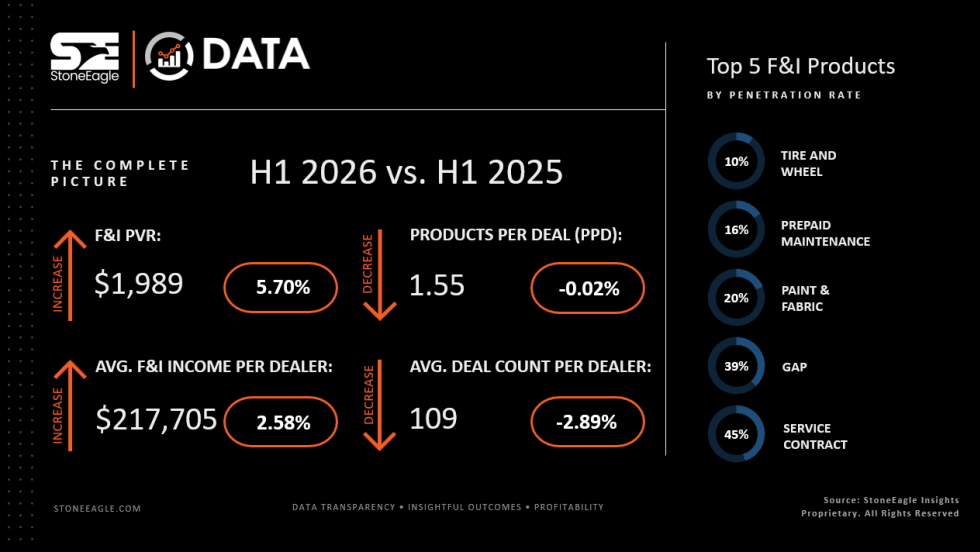
F&I Sales Give Dealers First-Half Lift
Product business shored up total profits to avoid an overall revenue tanking as product penetrations held steady, StoneEagle reported.
Read More →
Targeted Training Drives Results
Today’s technology, instead of threatening F&I managers, can actually make them better, according to an industry veteran who’s watched market setbacks roil the unprepared.
Read More →
Double the Change, Double the Chance
When an F&I manager gets a customer refusal, it’s a wise move to tweak more than one thing in the product offering.
Read More →
Just Do It
F&I managers need training, but instead of resisting application or expecting perfection, they should improve by simply acting on what they learn.
Read More →
Dealer Lender Preferences Revealed
When lenders provide consistent, fast service, their overall satisfaction scores with dealers greatly improve, according to JD Power research.
Read More →
Leading with Purpose
In this video, Trent White explains how understanding your people’s 'why' is a key leadership responsibility of F&I professionals and how that mindset drives dealership engagement, trust and performance.
Read More →
Integrating Nontraditional F&I Products
The niche presents a strategic advantage for auto dealerships as they move to adapt to fast-changing consumer expectations in today’s market.
Read More →
Trust Is Personal
Technology, no matter how efficient, can’t replace what the human F&I manager can do, which is to bridge the divide between cyberspace and the in-store experience.
Read More →