



Dealers Move Closer to Exemption From Wall Street Reform
The United States Senate demonstrated bipartisan support for auto dealers on Monday, voting 60-30 to approve a “motion to instruct” lawmakers to include the Brownback Amendment in future versions of the financial regulation bill.
WASHINGTON — The United States Senate demonstrated bipartisan support for auto dealers on Monday, voting 60-30 to approve a “motion to instruct” lawmakers to include the Brownback Amendment in future versions of the financial regulation bill. The amendment, authored by Sen. Sam Brownback (R-Kan.), seeks to exempt auto, marine and RV dealers from sweeping lending practices reforms.
“I am pleased that both the Senate and the House have taken positions on the financial regulation bill to include language to prevent car dealerships from being subjected to redundant regulations,” Brownback said. “It simply does not make sense to treat auto dealerships like financial institutions. Auto dealers are a part of Main Street, not Wall Street, and they are not responsible for the financial meltdown.”
The motion to instruct is a nonbinding but pivotal vote as the legislation heads to committee, where differences in the Senate and House versions will be worked out. Phil Brady, president of the National Automobile Dealers Association, was encouraged by Monday’s vote after months of campaigning on behalf of the organization and its associated dealers.
“Senators clearly understand that dealers are not lenders — they do not underwrite, fund or service auto loans,” Brady said. “They also realize that jurisdiction of the Bureau of Consumer Financial Protection over auto dealers is unnecessary because dealers are already effectively regulated by the Federal Reserve, the Federal Trade Commission and state agencies.”
Third-party financing currently represents about 90 percent of all auto loan originations in the United States, including financing through captive and independent lenders, finance companies and credit unions.
More F&I

AI: Facilitator, Not Fixer, in F&I
The dealerships that thrive in the years ahead will be those that embrace technology while continuing to invest in the people who make customer interactions count.
Read More →
Modern Technology Objection Handling
In this video, Trent White shares how to confidently handle technology-based objections by helping customers understand the value of protection, even with modern vehicle technology.
Read More →
Consistency at Scale: Driving F&I Performance
With 75 rooftops across the Sunshine State, Morgan Auto Group has proven to Floridians that it knows a thing or two about driving performance in a competitive market. But it didn’t start at the top.
Read More →
Gitty Up on GAP
The foundational finance-and-insurance product hasn’t kept up with the latest conditions for auto dealers. Is the time ripe?
Read More →
How AI-Powered Coaching Is Transforming F&I Performance
See how AI-powered coaching can turn F&I customer conversations into actionable insights that support compliance, performance and profitability
Read More →
Sell Value, Build Trust
In this video, Trent White explains why selling on value, not fear, builds lasting customer trust, reduces cancellations, and drives long-term success.
Read More →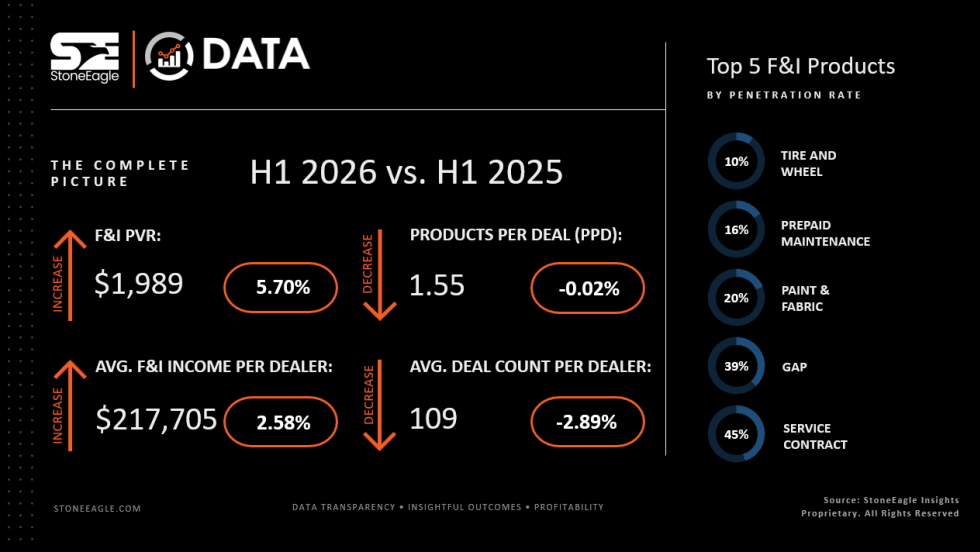
F&I Sales Give Dealers First-Half Lift
Product business shored up total profits to avoid an overall revenue tanking as product penetrations held steady, StoneEagle reported.
Read More →
Targeted Training Drives Results
Today’s technology, instead of threatening F&I managers, can actually make them better, according to an industry veteran who’s watched market setbacks roil the unprepared.
Read More →
Double the Change, Double the Chance
When an F&I manager gets a customer refusal, it’s a wise move to tweak more than one thing in the product offering.
Read More →
Just Do It
F&I managers need training, but instead of resisting application or expecting perfection, they should improve by simply acting on what they learn.
Read More →