



Distracted-Driving Laws Create Opportunity for Vehicle Makers, Dealers
As state and local governments continue enacting distracted-driver laws, consumers are increasingly looking for technology solutions to legally and safely make calls, get directions or check email while driving, according to the J.D. Power and Associates 2011 U.S. Automotive Emerging Technologies Study.
WESTLAKE VILLAGE, Calif. — As state and local governments continue enacting distracted-driver laws, consumers are increasingly looking for technology solutions to legally and safely make calls, get directions or check email while driving, according to the J.D. Power and Associates 2011 U.S. Automotive Emerging Technologies Study.
The study measures consumer interest and purchase intent for emerging automotive technologies, both before and after market price is revealed.
With government-imposed restrictions on the use of handheld phones while driving, the onus is on the automakers and their technology partners to find simple and effective solutions that will keep consumers happy while staying within the law. Technology providers that can best enable consumers to stay informed, connected and secure while driving stand to gain the most. Automakers may benefit from this new environment, but also take the risk that a suboptimal solution will create consumer dissatisfaction, damage their brand reputation and reduce consumer loyalty.
“The key for automakers and suppliers regarding hands-free technology, as with most technologies, is to integrate it into the vehicle in a way that is easy to understand and operate, yet sophisticated enough to handle all of the tasks that drivers expect,” said Mike VanNieuwkuyk executive director of global vehicle research at J.D. Power and Associates. “The engineering is extremely complex, but the driver interface has to be simple.”
The vast majority (86%) of smartphone owners indicate that they use their device while in their vehicle. The two most common activities are making or receiving calls and getting directions. When given the opportunity to select from 21 in-car technologies reviewed by the study, wireless connectivity systems receive the third-highest level of interest (50%). Additionally, interest in this feature remains fairly strong across all age groups, with a high of 57 percent among 18-25-year-olds and a low of 43 percent among 57-65-year-olds.
“Consumers want to make use of their smartphones while driving, and most are willing to pay for the technology that enables this,” said VanNieuwkuyk.
Consumers also show great interest in technologies they perceive will keep them safe. Features such as remote vehicle diagnostics, which provide owners with vital information on the performance and health of their vehicle, as well as rear-vision camera systems and blind spot detection received among the highest levels of interest after the market price for each feature is revealed.
The following are other trends uncovered by the study:
Given a market price of $200, nearly 60 percent of consumers who own a portable digital music player would like to integrate the player through their vehicle’s controls and display.
Among vehicle owners currently in a free trial period for satellite radio, 54 percent indicate they are “definitely” or “probably” interested in having the technology in their next vehicle at the market price of $12.95 per month.
Forty-five percent of smartphone owners are interested in technology that would enable them to use their phone as a remote control to start their vehicle, unlock the doors or open the trunk via a smartphone app at the market price of $300.
Among portable navigation system owners, 44 percent express interest in a $200 portable navigation device interface, which enables the system to integrate with the vehicle’s display.
The 2011 U.S. Automotive Emerging Technologies Study is based on responses from nearly 18,000 vehicle owners. The study was fielded in May 2011. The study includes 21 primary technologies, each with related secondary technologies; analyses on device connectivity, navigation, safety and premium sound systems; a key emerging technologies packaging exercise; an emerging technologies adoption calculator; and expanded psychographic and lifestyle-driven content.
More F&I

AI: Facilitator, Not Fixer, in F&I
The dealerships that thrive in the years ahead will be those that embrace technology while continuing to invest in the people who make customer interactions count.
Read More →
Modern Technology Objection Handling
In this video, Trent White shares how to confidently handle technology-based objections by helping customers understand the value of protection, even with modern vehicle technology.
Read More →
Consistency at Scale: Driving F&I Performance
With 75 rooftops across the Sunshine State, Morgan Auto Group has proven to Floridians that it knows a thing or two about driving performance in a competitive market. But it didn’t start at the top.
Read More →
Gitty Up on GAP
The foundational finance-and-insurance product hasn’t kept up with the latest conditions for auto dealers. Is the time ripe?
Read More →
How AI-Powered Coaching Is Transforming F&I Performance
See how AI-powered coaching can turn F&I customer conversations into actionable insights that support compliance, performance and profitability
Read More →
Sell Value, Build Trust
In this video, Trent White explains why selling on value, not fear, builds lasting customer trust, reduces cancellations, and drives long-term success.
Read More →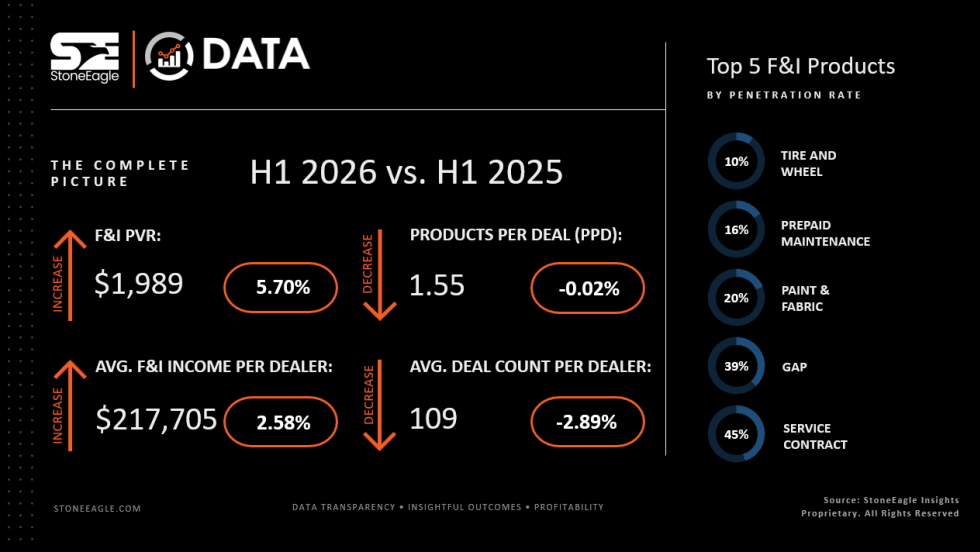
F&I Sales Give Dealers First-Half Lift
Product business shored up total profits to avoid an overall revenue tanking as product penetrations held steady, StoneEagle reported.
Read More →
Targeted Training Drives Results
Today’s technology, instead of threatening F&I managers, can actually make them better, according to an industry veteran who’s watched market setbacks roil the unprepared.
Read More →
Double the Change, Double the Chance
When an F&I manager gets a customer refusal, it’s a wise move to tweak more than one thing in the product offering.
Read More →
Just Do It
F&I managers need training, but instead of resisting application or expecting perfection, they should improve by simply acting on what they learn.
Read More →