



eMarketer: Mobile Ad Spending to Reach $7.29 Billion in 2013
Mobile advertising will reach $7.29 billion in 2013, and Google will take home more than half of it, according to eMarketer.
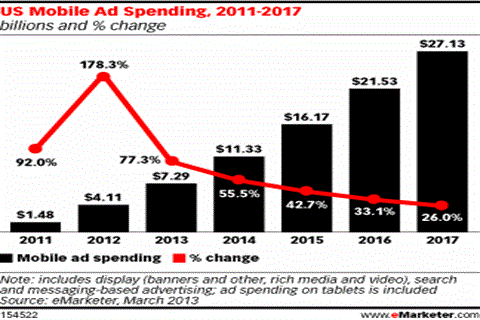
NEW YORK — Following explosive entrances by Facebook and Twitter into the marketplace, as well as a strong performance from Google, U.S. mobile advertising spending grew 178 percent last year to $4.11 billion, according to a new forecast by eMarketer. Spending, the firm said, is expected to rise a further 77.3 percent to $7.29 billion in 2013.
That’s a nearly fivefold increase in spending since just 2011 and includes ad dollars spent on display, search and messaging-based formats sent to all mobile devices, including tablets. By 2017, eMarketer projects U.S. advertisers will devote $27.13 billion to mobile — just less than 45 percent of all digital ad spending and 13.8 percent of total media ad spending that year.
Based on year-end reporting from several major mobile publishers — along with estimates from other sources, including research firms and eMarketer interviews with ad agency executives — eMarketer revised its estimate for 2012 spending only slightly upward from the previous forecast in December 2012.
While top-line figures were relatively unchanged since the previous forecast, there were some small adjustments in market share and revenues for some of the larger players following Q4 results.
Google, thanks to its dominance of the mobile search market and strong showing in mobile display, is by far the largest player in the space with 93.3 percent of U.S. net mobile search ad dollars going to the company last year. Overall, more than half of total U.S. mobile ad revenues will go to Google this year, and its share will grow by nearly 3 percentage points by 2015.
eMarketer believes further mobile monetization of YouTube will contribute the lion’s share of incremental growth to Google’s mobile display revenues, while search ad revenues will continue to rise rapidly.
Facebook, the No. 2 mobile ad publisher in the country, accounted for 9.5 percent of mobile ad revenues in 2012 and is expected to take 13.2 percent this year. In the mobile display market, however, Facebook is on top, projected to grab nearly three in 10 dollars this year. eMarketer revised Facebook’s share of US mobile display advertising ad revenue upward by several percentage points after fourth quarter results came in higher than previously expected.
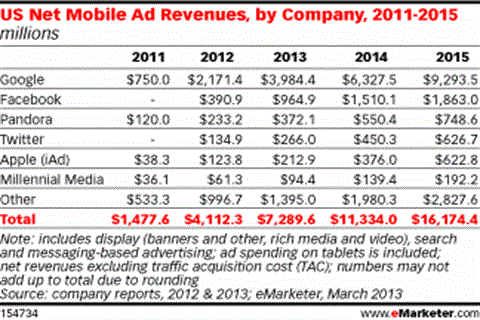
Google and Pandora round out the top three mobile display slots, with Twitter — whose figures were also significantly increased in the new forecast — making a strong push for the fourth spot. The microblogging service took in 7.3 percent of net U.S. mobile display ad revenues in 2012, the first year it offered such ads.
Both Facebook and Twitter have benefited from their use of so-called native ad formats that are seamlessly integrated within the core user experiences of their respective products. The resulting ability for both companies to deliver mobile ad impressions at much higher volume than many traditional ad publishers has helped them capture market share very quickly.
The most significant adjustment in the new forecast is a downward revision to Millennial Media’s mobile display ad revenues and market share for 2012 through 2015. The company’s traffic acquisition costs (TAC) paid to partners and ad publishers are not expected to fall in the next few years, as eMarketer previously believed. Millennial will take an estimated 2.8 percent of U.S. mobile display revenues this year, excluding TAC. Apple will come in slightly higher at 6.3 percent, eMarketer estimates.
More F&I

Modern Technology Objection Handling
In this video, Trent White shares how to confidently handle technology-based objections by helping customers understand the value of protection, even with modern vehicle technology.
Read More →
Consistency at Scale: Driving F&I Performance
With 75 rooftops across the Sunshine State, Morgan Auto Group has proven to Floridians that it knows a thing or two about driving performance in a competitive market. But it didn’t start at the top.
Read More →
Gitty Up on GAP
The foundational finance-and-insurance product hasn’t kept up with the latest conditions for auto dealers. Is the time ripe?
Read More →
How AI-Powered Coaching Is Transforming F&I Performance
See how AI-powered coaching can turn F&I customer conversations into actionable insights that support compliance, performance and profitability
Read More →
Sell Value, Build Trust
In this video, Trent White explains why selling on value, not fear, builds lasting customer trust, reduces cancellations, and drives long-term success.
Read More →
F&I Sales Give Dealers First-Half Lift
Product business shored up total profits to avoid an overall revenue tanking as product penetrations held steady, StoneEagle reported.
Read More →
Targeted Training Drives Results
Today’s technology, instead of threatening F&I managers, can actually make them better, according to an industry veteran who’s watched market setbacks roil the unprepared.
Read More →
Double the Change, Double the Chance
When an F&I manager gets a customer refusal, it’s a wise move to tweak more than one thing in the product offering.
Read More →
Just Do It
F&I managers need training, but instead of resisting application or expecting perfection, they should improve by simply acting on what they learn.
Read More →
Dealer Lender Preferences Revealed
When lenders provide consistent, fast service, their overall satisfaction scores with dealers greatly improve, according to JD Power research.
Read More →