



Protect the Payment
The budget-based close in an inflation-era showroom

The budget-based close is about showing customers how unprotected ownership can destroy a budget.
Pexels/Kaboompics.com
Today in F&I, one truth is becoming increasingly clear: The payment matters more than ever.
We’re operating in a market where inflation has reshaped the financial realities of our customers. From rising interest rates to skyrocketing repair costs, consumers are carefully evaluating the weight of every dollar spent. Combine that with a decade of stagnating wage growth and record household debt, and you begin to understand the critical importance of a budget-based close.
One of the most misunderstood objections we hear in the box is, “I just can’t add any more to my payment.” Often, that objection has less to do with price and more to do with confidence—or rather, the lack of it. Confidence in the coverage. Confidence in the product. Confidence in their overall financial picture.
And it’s our job to restore that confidence.
Claim Severity, Rising Reserves and Margin Pressure
Behind the scenes, claim severity is quietly reshaping the economics of the F&I office. Administrators across the board have increased reserve requirements—many more than once in just the past 18 months. Why? Parts and labor costs are climbing rapidly. Vehicles with complex advanced driver-assistance systems technology and connected systems now carry higher repair costs than ever before.
This rise in reserve requirements doesn’t come without consequences—it comes at the cost of F&I profitability. Either the advance from lenders is limited, capping what can be financed, or the cost to finance those products becomes too high, eroding your front-end margin. We’re being asked to do more with less room.
Add to that the customer skepticism bred by national service contract advertisers—many of whom exclude labor rates or include high out-of-pocket exposure—and it becomes clear: Product education and compliance have never been more essential.
A Budget-Based Mindset
The budget-based close isn’t about squeezing products into a payment. It’s about showing customers how unprotected ownership can destroy a budget.
Start by leveraging the credit report—not just to structure the deal but to understand the customer. Review the total number of open credit lines, utilization rates, and recurring obligations. Many consumers have four to five credit cards and are carrying balances north of 60% utilization. They’re surviving, not thriving. This is not the time to leave their finances exposed.
Then bring in real-world data. Use third-party cost-of-ownership tools and the latest J.D. Power Initial Quality Study. The 2024 study highlights a direct correlation between increased technology and early-stage issues. That tech-laden vehicle the customer loves? It comes with real risk. And protecting the payment means showing how the right coverage keeps a budget from getting blindsided.
Process Drives Profit
Many dealers fall short in consistency. The stores seeing the biggest jump in performance are the ones that have connected strong relational selling with disciplined process execution.
It starts with the trade. Evaluating the customer's trade gives insight into how he or she has treated the vehicle—and which protections they didn’t have that could have made a difference. From there, conduct a deep relational interview. Understand the customer’ driving habits, ownership experiences, and financial sensitivities. This informs not only what to offer but how to present it.
Then comes the art of the two- to three-minute menu presentation. Present each product with clarity and purpose. Ask smart qualifying questions early—ones that overcome objections before they arise. The best F&I professionals answer the customer’s silent concerns before they even surface.
Lastly, track what matters. What was the payment-in from the desk—and where did it leave finance? Are products being presold? Which ones? And how much is the F&I manager bumping the payment on average? When leaders truly inspect what they expect, they start seeing the gaps that are holding their numbers back.
Get this dialed in, and you’re looking at a $300 to $400 lift in per vehicle retail, and a 10%-plus jump in vehicle service contract penetration. Consistency breeds results.
Consistent Profit, Strategic Product Mix
According to the Haig Report, F&I has been the most stable and consistent gross profit center in the dealership since 2014. While front-end margins have fluctuated with inventory cycles and incentive shifts, F&I has steadily climbed.
But that climb depends on product strategy. A dealership’s F&I menu must be diversified and dynamic. That includes:
High-mileage VSCs to protect used and aging inventory
Bundled product offerings that align with customer needs and create value
Hard add-ons that generate more reinsurance reserve and long-term wealth
Reinsurance structures that provide ownership, tax efficiency, and investment yield
When you build a product strategy around the customer and the store’s long-term profitability, everyone wins.
Connection Is the Close
In the end, this business is still about people. And connection will always outperform routine.
The best F&I professionals know how to relate. They listen with intention, present with empathy, and create clarity where there was once confusion. That relationship doesn’t lead to just a better close—it builds the kind of trust that drives referrals, retention and lifetime value.
In an inflation-era showroom, our role has expanded. We’re not just here to protect gross—we’re here to protect the customer. Not just to sell coverage but to serve people. And when we lead with that mindset, the results always follow.
Chad Staples is president of Elevation Dealer Services, where he helps U.S. automotive dealers maximize profitability through strategic F&I programs, reinsurance structures, and long-term wealth-building strategies. He also leads modern, relationship-based F&I training.
EDITOR’S NOTE: This article was authored and edited according to F&I and Showroom editorial standards and style. Opinions expressed may not reflect that of the publication.
More F&I

AI: Facilitator, Not Fixer, in F&I
The dealerships that thrive in the years ahead will be those that embrace technology while continuing to invest in the people who make customer interactions count.
Read More →
Modern Technology Objection Handling
In this video, Trent White shares how to confidently handle technology-based objections by helping customers understand the value of protection, even with modern vehicle technology.
Read More →
Consistency at Scale: Driving F&I Performance
With 75 rooftops across the Sunshine State, Morgan Auto Group has proven to Floridians that it knows a thing or two about driving performance in a competitive market. But it didn’t start at the top.
Read More →
Gitty Up on GAP
The foundational finance-and-insurance product hasn’t kept up with the latest conditions for auto dealers. Is the time ripe?
Read More →
How AI-Powered Coaching Is Transforming F&I Performance
See how AI-powered coaching can turn F&I customer conversations into actionable insights that support compliance, performance and profitability
Read More →
Sell Value, Build Trust
In this video, Trent White explains why selling on value, not fear, builds lasting customer trust, reduces cancellations, and drives long-term success.
Read More →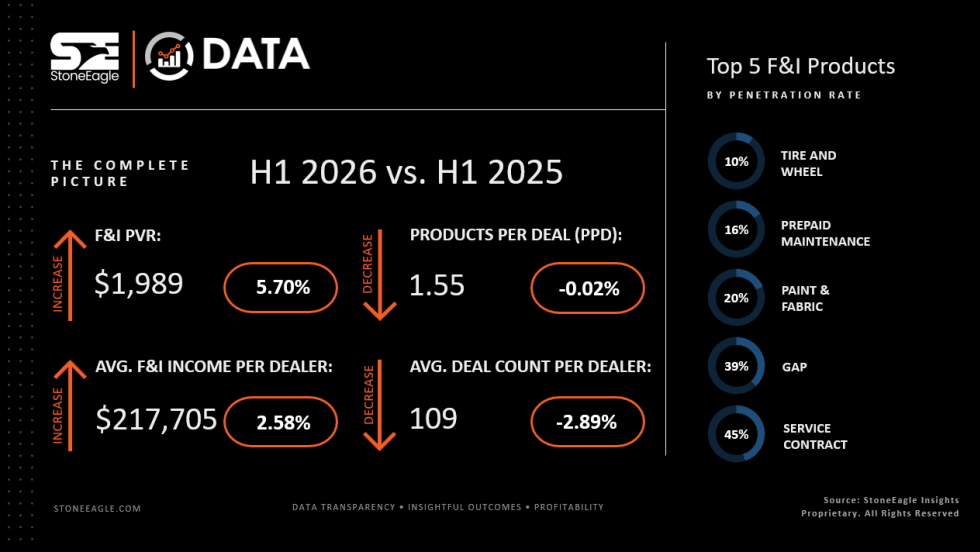
F&I Sales Give Dealers First-Half Lift
Product business shored up total profits to avoid an overall revenue tanking as product penetrations held steady, StoneEagle reported.
Read More →
Targeted Training Drives Results
Today’s technology, instead of threatening F&I managers, can actually make them better, according to an industry veteran who’s watched market setbacks roil the unprepared.
Read More →
Double the Change, Double the Chance
When an F&I manager gets a customer refusal, it’s a wise move to tweak more than one thing in the product offering.
Read More →
Just Do It
F&I managers need training, but instead of resisting application or expecting perfection, they should improve by simply acting on what they learn.
Read More →